

Look on pretty much any digiscoping website and you will see the same story being told of digiscoping being invented by a Malaysian in the late ’90s. Laurence Po turned out to be an incredibly gifted photographer and ambassador of digiscoping.
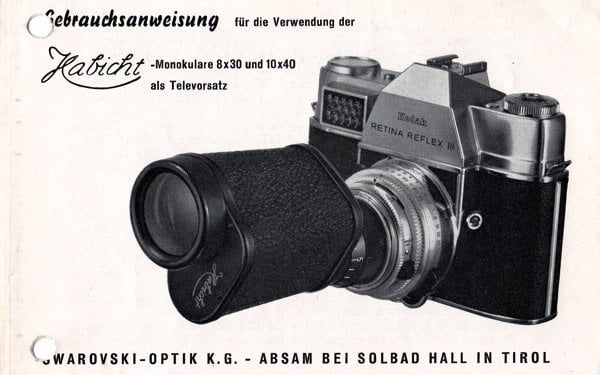
Instruction manual, May 1962
A few days ago, one of our assistants (Beate, a lady of wonders!) came to me with a photocopied brochure from the 1960s – a user’s manual of a “Habicht Monocular as Tele-addition”. So, I made a few phone calls and quickly found someone with a small collection of great, old catalogues and brochures (our VP for Quality Control). Franz has a wonderful store of knowledge and a real fascination for optics, optical theory and anything remotely related. Brilliant man. Anyhow, Franz produced the goods; brochures and pamphlets and other goodies.
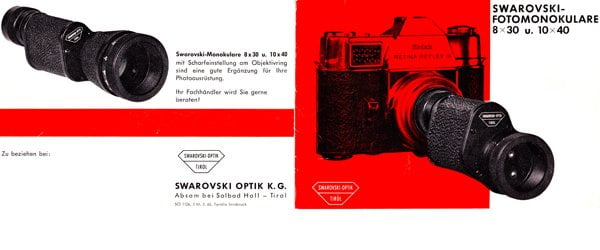
Swarovski Optik “Photo monocular”, March 1965
From what I understand, in the early 1960’s Swarovski Optik decided to make a monocular – basically a half porro-prism binocular with an integrated focussing ring – which was marketed primarily as an optical tool to attach to the front of a regular camera. We also found a list of cameras, their objectives and the necessary adapter ring needed to screw the whole thing together. Kinda like a binocular snap shot adapter 50 years before it was even invented. The instruction manual does a great job of describing how to set it up, how the system works and what to do. I particularly liked the description of how to operate it:
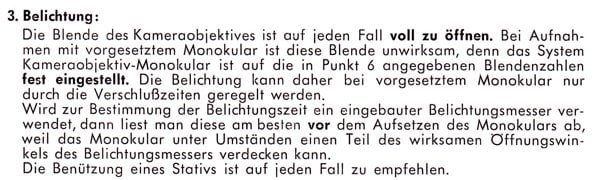 Photo moncular instruction manual, March 1965
(I’ll loosely translate and summarize): “The camera’s aperture should be opened completely. When using the monocular, the aperture in your camera’s objective is ineffective as the entire system has a fixed aperture. Exposure control can consequently only be controlled by varying the shutter speed. … The use of a tripod is recommended.”
The only things that have changed in the last 60 years is that we now have digital cameras with accurate integrated light meters and the ability to adjust the ISO on-the-run. But the basics have remained the same: Aperture completely open.
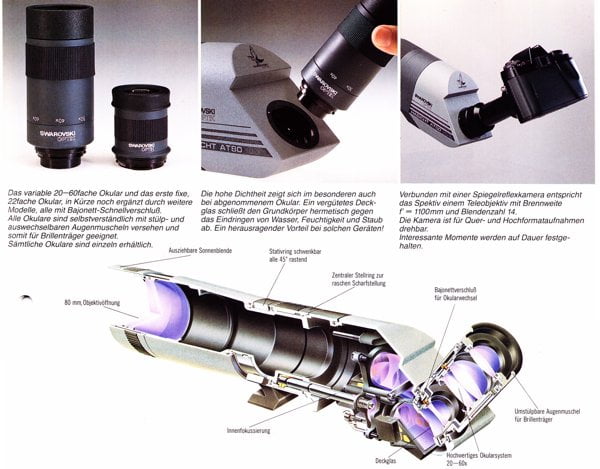 1100mm camera adapter, January 1991
When the AT80 HD telescope was released in the early 1990’s, they released an adapter that replaced the telescope’s ocular to allow one to directly attach a film camera to the telescope, resulting in an effective focal length of 1100mm. Shortly after the release of the 1100mm photo adapter, Swarovski Optik released an additional 800mm telephoto adapter. These were the predecessors of the current TLS800 digiscoping adapter, designed for the digital age.
Now I suppose before we can start talking about when digiscoping started, we really need to have a unified definition of what exactly digiscoping is. Many would call digiscoping something close to how birders got in to it – a compact digital camera held up or supported behind a spotting scope. This general type of photography – afocal photography – is really not that new at all; astronomers have been doing it for a very long time (astrophotography). The only difference being that we now have digital cameras to play with. But I suppose we could also assume that the astronomers were also quickly on to that game given they had been using SLRs and little compact film cameras so intensively. We could also try to draw a separation between traditional astronomy telescopes and field spotting scopes, but I am not so convinced that there are any clear lines there either.
At any rate, we are not the first to think about taking photos through great big observation lenses, and we are unlikely to be the last – it is, after all, a whole lot of fun!




Groundbreaking historic research here on 10,000 Birds! I love it!
Perhaps a new term needs to be coined though…maybe “Filmiscoping” would work?
mmm, not sure about groundbreaking but it sounds really fancy so let’s call it that.
It has inspired me to think about going digging through the attics and cellars a little more. In fact, the last time I was down in one of the really old cellars I found a mounted Northern Goshawk that was mounted outside the old CEOs office at the time when our top optical products bore the brand name “Habicht” (a Northern Goshawk and the name of a prominently, big mountain seen from the factory). I rescued her from the doldrums and transferred her to one of our optical test laboratories so we can use her fine feather detail and variety of barring for “field performance” comparison tests under lab conditions.
Filmiscoping. mmm, think I am going to have to go re-name/write the wikipedia page (inspired by Duncan, of course)
Cool blog post! Nice little historical tid-bit.
In the late 70’s, my girlfriend purchased a simple adaptor, easily obtainable at that time. It attached her camera to my spotting scope (she would write “it attached his spotting scope to my camera).
It seemed like a novelty and we didn’t pay much attention to it. Sigh.