
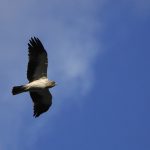
Perhaps one of the best known bird poems, Alfred, Lord Tennyson’s “The Eagle: A Fragment” packs a punch as powerful as a Golden Eagle‘s in merely six lines. First published in 1851 in the seventh edition of Tennyson’s Poems, it became a favorite and is now frequently anthologized. The alliteration and assonance utilized by Tennyson let the lyrical verses roll off of one’s tongue and the imagery of the poem is as simple as the rhyme scheme but memorable. The first time I got a good view of an eagle’s talons I immediately thought of “crooked hands.”
The Eagle
He clasps the crag with crooked hands;
Close to the sun in lonely lands,
Ring’d with the azure world, he stands.
The wrinkled sea beneath him crawls;
He watches from his mountain walls,
And like a thunderbolt he falls.
Tennyson employed the pairing of two-syllable adjectives with one-syllable nouns to help keep the meter of the poem intact. Indeed, Tennyson used no other adjective-noun combination, just “crooked hands,” “lonely lands,” “azure world,” “wrinkled sea,” and “mountain walls.” In fact, he used no word longer than two syllables until the last line of the poem where the three syllables of “thunderbolt” stand out to the reader, much as a loud clap of thunder would draw one’s notice. It conveys power, which any eagle certainly has.
The only thing that really bothers me about the poem is the idea of an eagle falling like a thunderbolt. If the poem was called “The Falcon” it would make more sense to me as I can easily picture a Peregrine Falcon falling like a thunderbolt. Despite this seeming inaccuracy the imagery of the poem is what stays with me and what makes the short six lines so poetic. Whatever you call it the poem is one for the ages.
…
If you liked this post and would like to browse the entire archive of poetry posts on 10,000 Birds please check out our Bird Poems page.
…







Oh yay, I was hoping you’d do this soon! I like this analysis – thanks for posting. Now I look forward to your HDM post. 😉
I like the first line. It describes the eagles (and other raptors) that I have seen really well.
Perhaps he was describing some sort of courtship? Bald Eagles often lock talons and plunge earthward.
Anyway its a thought.
Corey, you should read Jeff Watson’s The Golden Eagle. Page 49:The eagle soars at a great height before making a sudden, rapid descent resembling the vertical stoop of a Peregrine Falcon. . . . It is likely that a variation on this method is used by Golden Eagles hunting colonial seabirds in parts of western Scotland.” So, let us tip our hats to the great Lord Tennyson’s poetic, but accurate, powers of description. Thus our eagle like a “thunderbolt” falls toward the “wrinkled” sea far below. Love it.
@Pam: Thanks for the idea…
@John: I agree wholeheartedly!
@Will: Tennyson really emphasizes the eagle’s solitude…
@Alan: Hmm…maybe I am guilty of parochialism by really only taking into account my experiences with Bald Eagles. Thanks for the info!
i am bothered about what the line mean to an eagle the it is like a thunderbolt he falls please give me a concise explanation about the poem the eagle.
oh my god! i love this poem so much,
im so glad you put up an analysis.
:D:D:D:D:D:D:D:D:D:D:D:D:D
omg! this is the poem ive been looking for!
its so amazing! i nearly cried reading it :/
its really made my day…
thank you (:
i love you
keep up the good work (:
xxx
What is the rhyme scheme of this poem
@Brad: It is AAA BBB.
I read this poem thirty five years ago as a first year student. It is so powerful, it stayed indelibly etched in my mind, giving credence to the adage of old: ………poetry is what was always thought of, but never so well expressed. This is a timeless piece
what is an example of assonance in this poem
@rose: If you are looking for help with your homework, well, I would say to google search assonance and then figure it out. Good luck!
I have to do a report about this poem, here is a few of my questions:
Does the poem have any more parts to it?
Did Alfred Tennison make any more poems?
From Calah, age 10 2009
@Coolgirl: No and yes.
You can liken the eagle to a christian and the sun to God .
Close to the Sun in lonely lands – that is a beautiful way to say how it is to know God in a world that does not hear or see him.
The enlightened that see all from up high fall back into the world like a thunderbolt.
Great poem .
@Gladstone: I guess you could, but why would you?
l heard the poem earlier today and that was my first thought . Was Tennyson a christian ?
Thanks i’m using it for lamda! i love it
🙂 😛
I love this poem 🙂
if you read this poem without knowing the title you get a totally different meaning … it can be described as an old man getting closer to death or god or just the changing from youth to adulthood.
AwEsOmE!!!!!
I have this poem tattooed on my back 🙂
as a young grade 7 (1971) lad, growing up in tropical africa (ghana) we studied and memorised this and other exciting poems(including the wind).This was my very favorite poem. We were excited to learned about describing the sea as “wrinkled”. Each time i go the beach or see a body of water i try to look if it is indeed wrinkled. Your guess is a good as mine if you see the deep lines, strokes, and the curves on the water. The ending words of both the first and second standards are indeed standardised. the rhyming words are excellent and so sweet to the ears. the magic of the internet has brought back this nostalgic memories. i am asking the question “where is everybody who studied with me at grade 7?”
The eagle represents the hierarchy of the time, kings, bishop, ect., and how they have placed themselvs above all. The distance they have placed themselves is dictated by placing you in the same eyes of the “eagle”, the wrinkled sea beneath him crawls. When he descovers himself to be mortal by his downfall and comes crashing to earth. The first line uses the word “hands” and his ability to hold on is shown how he is holding onto the mountain walls, “He clasps the crags with crooked hands;”. Alfrad also used words to audibly to convey the meanings, especially when you read the poem aloud. The word structure makes the line difficult to say the words smoothly.
Alfred Lord Tennyson was knighted in 1884 by Queen Victoria for his written works such as “The Eagle”.
Why do people look to see something symbolic in Tennyson’s poems. He has seen what I suggest is a sea eagle (osprey), common at that time in Northern Britain. It has recently been reintroduced and is now resident in parts of Scotland. That simple. He describes it superbly – a magnificent bird and a magnificent poem.
I was looking for this poem and ran across your analysis.
If you ever hear a choir is going to sing this; go!
Each line except the last is sung twice (first set of voices tenors and altos, second set baritones and altos folding over the first set almost like a round) until the last line… which is only sung once and loudly by deep male baso-profundo voices that drop ‘falls’ to the deepest note you’ve ever heard… the auditorium walls will rumble!
I meant to write first set of voices is tenors and sopranos (the high voices)
I felt like the eagle is portrayed as a thievish creature, grappled to the heights of crags in desperate attempt to approach the sun. This poem mirrors icarus’ fall from divinity. The Eagle is notorious for stealing prey from fellow birds; so, the “crooked hands,” could be taken literally or figuratively. Just as it seems keen on remaining an idle in the sky, it plummets to the tumult of the mortal sea, something that it once saw from as high as can be.
Just as Icarus, the Eagle shall plummet; for he is not a noble bird.
This made me cry. It’s made me rethink the way i live my life. You see i’m an alcoholic. This has made me stop drinking.
Regards,
Adam
Dear all,
I’m planning on setting up an Eagle society. This poem has inspired me to do so.
This poem is amazing and issy i would like to know more about your Eagle society I would really love to join. This poem has really inspired me too. If possible i would like to know an email address to contact you and know more information on this society since I think that many people would join becasue of this poem.
Issy I love you and what you are doing
Ben
P.S. I think that my brother is only second to God
Why does the eagle have crooked “hands?”
Is the lonely land close to the sun, the end of life? Is the azure world heaven? Why the odd comma before he stands in the third line. Is this an old man who is about to die and when confronted with death stands up?
Why is the sea wrinkled and why does it crawl?
Is this man/bird dying or hunting?
A poem I learnt at school over 50 years ago and can still quote it verbatim (with one error, I’m inclined to use ranged instead of ring’d) with the emphasis on the last word. It was introduced by my English Teacher, as a magnificent description of a magnificent bird – no symbolism intended.
i like it shows the development of life just the eagle….nice
it represents the life and the way of a eagles life. i like it 😉 xx
This poem has inspired me…:D
Good on you Adam.
I think this poem conveys the power of the eagle, and the humility of the sea that swirls beneath. But I can’t help but think, it seems to depict the eagle as lonely, with only the sun as its companion..?
I’m quite young (“The eagle” was part of my homework) so I’m not sure….
Relating to “Laura’s” comment, I believe that the eagle is portrayed as wise, and pensive, just like an old man.
Anyway.
I’m glad I got that homework 🙂
i think the theme of this poem is “the rise and Fall in humanity”
no matter how great and high you are (Eagle), you will still Fall for hunting to Live your Life, and this is its reference. so, What are we? nothing as compared to the eagle, which is the best and they have pride.
with regard to “Ned”‘s comment, the poem says the sea crawls because the waves are earthbound things, forced to “crawl” continually on the ground; it allows us to see the world from the eagle’s perspective. The high cliff and the sky are depicted as part of another world, one that is nearer to the heavens than to earth.
Do not be bothered by the eagle falling like a thunderbolt, instead of a falcon. A thunderbolt is not the same thing as lightning, in literature and in life. When Tennyson’s eagle falls like a thunderbolt, Tennyson means what he wrote. And when you are a fish being picked up by an eagle, it was a thunderbolt that hit you. Do not be bothered by an eagle being a thunderbolt.
It’s being a thunderbolt when you fall from the sky. It’s not being an eagle or a falcon. It’s being a thunderbolt when you fall.
I love this poem and ”Abby” i totally agree with what you said about the ”crawl” continually on the ground just like us humans it truely has opened my eyes to a whole new world.
I LYK EAGLES 😉
what is the purpose?
The point about the thunderbolt seems fitting, as thunder rumbles with strength and falls in the sense of power and strikes fear. Whereas, the falcon strikes with power and quickness, more like a lightning bolt. I totally understand Tennyson’s poem. The whole poem befits an eagle in the wild, where one sees him, and the way he is seen.
I really like it thanks
Alfred Lord Tennyson is actually telling us the way of a man. Line by line, the poem means…(1)He does his role in his own little ways,(2)from learning the nature of things around (3)within the limit of senses. (4)With much desire from his heart, (5)and from the way he sees things (6)he acts according to his knowledge, choice and ability…. The metering technique is very substantial in pointing out the existence of a man with thought, emotion and action given his niche to learn and act within his limits; thereby, vibrating in between two poles of negativity and positivity in the process of generating a cause for an effect of his beingness….
RE : “The only thing that really bothers me about the poem is the idea of an eagle falling like a thunderbolt.”
Try reading the lines as symbolic – the Eagle is dominant in legend
and myth and used historically as an ideological symbol.
A symbol can have many meanings – perhaps the poet was trying to express human psychological aspirations ?
Anyway, thanks for making the poem available online.
Thank you, “CinDi Martin” I really like how you described thunder and explained why Tennyson used thunder instead of lightning; “thunder rumbles with strength and falls in the sense of power and strikes fear. Whereas, the falcon strikes with power and quickness, more like a lightning bolt.” I totally agree.
This poem can be interpreted as an old man dying, seeing the better world he is passing into only as a fish views that which is above the water; viewable, but unattainable without death. This can also be taken (semi)literally, that it is an eagle plunging off a cliff. I think if it is an old man dying, he most certainly faces it with ALL the dignity and grace of an eagle.
I must admit, though, that the old man dying was my very first interpretation of this poem.
For Ned, who wrote more than a year ago to say that he was bothered by the comma in line 3.
It is not “he”, the eagle, who is ring’d by the azure world. It is “lonely lands” which are ring’d by the azure world. Thus syntax requires either two commas or none. I believe that the poet made the better choice in using the two commas.
pleeeeeez help me >>>
I wanna u to tell me how can I write about the theme of life in this poet>>>
I wanna use good english
very important pleeeez
Corey have you ever watched an eagle catch its prey? I assume you have not, as all the eagles that I have seen will stay high above the earth to the point where they are almost impossible to see with the naked eye. Once the eagle spots its prey it will close its wings and drop so fast the eye has a hard time following. Just as the eagle reaches its prey it will spread its wings, abruptly stopping its descent, and flapping its wings the eagle will rise up from the ground or water with its prey. It is a very unique experience, I grew up not far from a place where eagles nested and often would spend my weekends watching them in a natural setting. The analysis of the poem is good though, and I enjoyed reading it, continue posting literature of this nature.
A video showing an Eagle Owl in blight is at
http://www.dogwork.com/owfo8/
t
a video showing an Eagle Owl in flight is at
http://www.dogwork.com/owfo8/
The poem is about Eagle which is considered as the king of all birds.Tennyson says that being a great bird,the place where it lives is also a place having no boundries.It lives high on the peaks which is surrounded by blue sky all round.He also describes how suddenly it falls upon its prey like a thunder from the sky.
The eagle, by Alfred Lord Tennyson, is a truly fantastic poem with many meanings behind it, for example; ‘He clasps the crag with crooked hands’
is a visual effect, it represents the claw of the eagle.
I love the way that everyone can have their own picture of the eagle,and how there are so many different meanings hidden behind certain words.
From my perspective, it seems to me that this Eagle is in his final moments, being “crooked”, being “Close to the sun” where the sun symbolises happiness. To me it seems like the eagle is close to eternal happiness or as it sounds to me, death, in “lonely lands”. As he watches from “mountain walls”, he falls to his death like a thunderbolt.
Please correct me if I’m wrong.
this poem is about ALT himself….he was a man of the Victorian age as it became the industrial revolution. he is the eagle….he is the aged person that has outlived his time….the ‘lonely lands” is the point in our lives when we recognize our obsolescence. The time at which he lived was a paradigm shift ..not unlike the time in which we live now……people try to read far too much in a poem….it is what it is….it is very apparent…
Ken, you try to read too much into the poem. It is not about ALT himself.
Mary Krimmel
Gladstone,
Tennyson was writing poetry at age 17, possibly sooner. He was born in 1809, first published in 1851.
Mary Krimmel
Matthew,
I think that you mean “an idol in the sky”, not “an idle in the sky”.
Mary Krimmel
Someone asked whether Tennyson was a Christian. Since his father, maternal grandfather, and other near relatives were rectors or other churchmen, I think that we can assume that Tennyson was at least a nominal Christian throughout his young years. As Darwinism became much discussed, he was disturbed by the apparent gap between new ideas and old beliefs. Whether he continued to call himself Christian we can only conjecture.
My own conjecture is that he continued to call himself Christian but had serious doubts about the truth as expounded in the King James Bible. At the time the possibility of being both a Christian and a Darwinian had not been recognized.
Mary Krimmel
what does the eagle represent in Tennyson’s poem ? How would you describe the eagle based on the poem ?