

Some photographers seem a bit too anxious to get the perfect lighting for all their photos and go to great extents bothering the birds with extra light and flash for one perfect picture. I have always tried to take my pictures without flash to prevent scaring the bird and also to get the most natural look to my pictures. Also I can get multiple pictures (my camera can get some 5 to 10 frames per second) of the same bird in different positions and sometimes this leads to the one out of many shots that is really good.
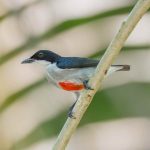
Under low light conditions the situation gets more difficult and the need for using a flash becomes more severe. But I have learned that today’s technology will allow for some nice shots (not perfect) without the use of flash. For example here is a shot of a Ocellated Antbird at ISO 3200, 1/50th sec, f 5.6 with a 100-400 mm Canon zoom.
 Ocellated Antbird
I took about 20 photos of this bird and only two of them came out very good, the others where a little fuzzy because of my shaky pulse. If I had used flash the bird would have fled with the first shot. Also I found that by taking the photos in RAW mode produces better results, especially in low light conditions. The RAW format has more information and you can get more noise out of the photo and the resulting colors are more vivid. Here is a photo comparing jpg vs RAW at ISO 3200, 1/500th sec, f 5.6, with a 100-400 mm zoom.

So it is possible to get good pictures under low light conditions and without flash. Of course there are limits, for example it would not be possible to get some good pictures without some artificial light in the dark.
So why do some photographers insist in using flash? The real flexibility that a good and powerful flash can provide is really amazing. With flash you can manipulate depth of field, speed, and ISO all at the same time! No more do you have balance between all of the parameters. How does that happen? It is no magic, you simply set your camera in manual, set the f stop that you want, set the speed that you need, set the ISO to some ideal number and BAM! The flash will adjust its power automatically to meet your requirements. Of course if the flash does not have enough light then the picture would be dark. There are limitations but for close photography (less than two meters) the results can be amazing. Here is an example of such a photo with and without flash. Note the greatest depth of field with flash, the camera settings are shown in each photo.
 f3.5, 1/100 sec, ISO 400 NO FLASH
 f32, 1/200th sec, ISO 100 WITH FLASH
This flash magic has been well known for some time but what I did not know is how it is used, or shall I say abused, to get the best possible bird picture! Just imagine that you can set ISO to 200, speed to 3200, and f stop to 6 and take a perfect hummingbird picture under poor light conditions? Well that is exactly what some photographers do and use multiple wireless flashes to get enough light needed to get those amazing ideal conditions for bird in flight photography. In comparison here is a hummer in flight taken without flash.
 f5.7, 1/1328 sec, ISO 3200 NO FLASH
So this is not bad for a shot taken under real light conditions. But now go to Google, click on image search, and type hummingbird flash photography. You will get the most amazing photos with perfect backgrounds, color, light, sharpness, etc. Or if you have purchased some bird photographic books just open and look at the amazing photos.
So what is wrong with using flash? I searched this information in our superhighway and found that there has been some studies that conclude that no permanent damage is done to the birds by exposing them to flash. Here is one such link: http://photo.net/learn/nature/owlflash
From the information available it seems that it is OK to use flash but I am not so sure from my experiences. In most cases the (wild) birds are spooked by the flash but can seem impervious to it in places where people take a lot of flash pictures.
I recently witnessed a flash photographic shoot-out that shocked me and led me to write about this subject. This was a Wildlife Photography Tour aimed at hummingbirds. The tour leader removed the hummingbird feeders from the lodge and put a flower with a fake background, and an empty feeder nearby. The hummers that have been depending on the feeders for many years now had the only option of feeding on this flower that was perfectly aimed by five wireless flashes! The hungry birds where flying everywhere looking for food and when they went to the center stage they got nailed by these flashes that froze the bird in flight with perfect sharpness, depth of field, perfect background, and at amazingly low ISOs.
Later I found out that this group of photographers have been doing this for three consecutive days, taking turns at the shootout, and that there was another group that just went through this lodge doing the same thing just two days prior. This was torture and it was evident when I almost stepped on the hummingbirds that were on the floor trying to get sugar out of the empty feeders laying nearby.
I wonder if there was enough supplemental food for the many hummingbirds that have always depended on the feeders?
I wonder if there are any studies that take into account the hundreds of powerful flashes that these birds were being exposed for many consecutive days?



I don’t use flash for birds partly because when flash is used the birds usually fly away but most of all I am worried about the effects on the birds themselves and how it might affect them when they had been flashed if a predator were nearby. I worry about the hummingbirds that are subjected to the multiple flash set ups and what you have described about your experience just amplifies my concerns.
The photo IS never as important as the subjects well being.
I used flash at the very beginning of my bird-photography career more for misinformation than anything else… I got now about 4 years without using the flash at all and not only my birds feel easier, but the colors of my shots are real… and you can say vivid, as I’ve learned how to get the very best out of the settings of my camera.
With the right accessories (sturdy tripod, good head and remote -cable- shutter- one can achieve the best, even in the poorest of light conditions.
I would like to share an example, to prove my point… Notice that the portrait here, was obtained at 1/3s with 200 ISO!!!
http://www.pbase.com/alex_vargas/image/137077281
Cheers!
Beautiful picture Alex. I don’t use a flash for birds either because the birds would be gone. I’ve found that a tripod and patience works best.
I never use flash for wildlife photography, and I’m with Mia on the importance of the animal’s well-being over the image. I’ve read articles by a few photographers who do use flash, who say that the only appropriate and non-intrusive way to use flash photography for animals is by flashing from the direction of the sun, thereby emulating the light already illuminating the bird. In those instances, the impact of the flash would apparently be nil or so minimal as to not cause disturbance. But flashing in dark scenarios, or in situations where the flash is shocking or apparent to the animal, goes way beyond my idea of ethical wildlife photography. No photograph is worth that type of disturbance or hazard.
Regardless of the debate of flash vs natural light in Wildlife photography, the situation at the hummingbird feeders has nothing to do with flash photography. What that describes is the abuse of wildlife by manipulation of them to obtain a photo. I can describe a similar setup that did not use flash. A well known photographer from my youth described to me how he obtained some photos of a Black-capped Chickadee at a nest hole. He plugged the hole with tissue preventing the bird from feeding its young until he had gotten the images he wanted. This was in the days of film and he shot a number of rolls “just in case”. No flash was used in the harming of those birds.
Clare, what a wretched act that guy perpetrated. It’s hard to hear those stories. A couple of years ago, a popular photography magazine featured a photo of baby birds gaping in the nest. It was one of their prize winners. The brief caption said that the photographer had seen the nest on his way to work, raced home for his gear, and then setup near the nest to get the shot. There was no explanation for how intrusive his “setup” was or if his presence (most likely) dissuaded the parents from feeding the young, or if his scent trail may have led predators to the nest, which is always a possibility. The photo and lack of cautionary note was setting the worst example for others who saw this closeup of babies as an award-winner. Unfortunately, this happens way too often.
It seems a lot of these so-called ‘nature’ photographers know next to little about the needs, much less the welfare, of their subjects.
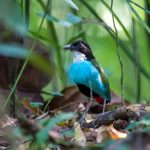
A Singaporean biology student made some unpleasant observations recently of pishers versus a mangrove pitta (critically endangered in the country): http://g33k5p34k.wordpress.com/2012/01/26/birders-behaving-badly/
The response from the community is at best questionable – at worst, shows a total inability for reflection or assumption of responsibility, see http://www.clubsnap.com/forums/world-nature/1037143-birds-pishing-re-mangrove-pitta.html The attempted retort that the student had ‘revealed’ the locality of the bird is moot as the pitta’s location was already well-known for several weeks, it resides in the mangrove portion of a public park that’s heavily visited by the general public, and the mangrove portion of the park has an elevated boardwalk from which visitors are not supposed to descend. Something about these photographers (their expensive gear, obsession with rare and beautiful shots….) seems to give them a sense of entitlement and immunity from criticism.
I scarcely ever use flash for reasons beyond the bird’s welfare (which I put first anyway, being a birder with a camera rather than a bird photographer).
I don’t own a flash in the first place, and the camera’s built-in flash produces ugly eye reflections and is of very limited range. Furthermore, I find bird pictures with flash simply boring because they are too perfect and artificial. Being a birder, my main interest in bird photographs is getting a feeling of what it is like to see a particular bird in the wild. I see hummers with blurry wings, so why would I want to see the fine microstructures of a hummer’s primaries in a flight shot?
Furthermore, in much the same way as Nico McBrain considers a double bass pedal undrummerish, I consider a flash mostly unbirdphotographerish: it is too easy, a cheap trick to make things simple.
Having said all that, I must admit though that I am frequently frustrated that my camera limits me to a max. of 1600 ISO, and that the graininess is then so bad that I can’t really go beyond 800. I therefore feel the lure of the flash and am not entirely sure how I’ll manage decent bird pictures once/if I do get to go birding in Indonesia in April this year.
I feel fortunate that the bird photographers I’ve met in the field are the kind that take photos of birds in the wild without any set-up, sometimes waiting hours and hours for THE shot. The kind of bird photography tours described here are from another world.
Good post, Renato. I’d like to hear more about your nature photography techniques.
Renato,
Thanks for nine days of intensive birding. Our total group of six men traveled 1000 miles around Ecuador and observed approximately 300 species. I never dreamed I would see Andean Condors.
I would encourage anyone interested in South American birding to contact you for a great trip.
Thanks
Gene McDonald
Dear friends,
Thanks for your thoughtful contributions. This blog is not only about birds but also about people who care about birds. I feel very fortunate to be part of this 10,000 Birds blog.
Recently, I found out that one of the BEST hummingbird (so-called) photographers, actually traps the birds and puts them in a large cage where the only option for feeding is his multiple-flash camera shoot-out setup. I have seen many of his pictures in books, nature videos, and the internet. He is handsomely rewarded as the best by National Geographic!
Renato, that is very distressing to hear. When I look at published wildlife photos or contest winners, I tend to scrutinize them for signs of this very type of thing. One can’t be sure, of course. But, it still amazes me that reputable places will reward photography of owls, for instance, that have most probably been baited with live mice — when you look at the approach toward the photographer and the wing position and so forth.
I stumbled on to this. I shoot birds in the wild, in the jungle. Away from others. I use flash all the time. Not just some time. And I have not once found a bird that was actually upset. I have had two that I can think of that flew away. It startled them just a little, Not much. 99.9% of the time I never see a reaction. So I think this is just not true. I do think. If what you are saying about the hummingbirds is true. Then that should be addressed seperately. That is just cruel and extremely bad birding. I or no one I know would be part of that.
Reguards,
Thanks Gary, I find that the colors are more real without a flash. I have made it a challenge to improve on my images without the use of flash. I now own a Canon 5D3 and can produce great images at very high iso.
Thank you for this great article and to all of the many great commenters. I personally never use disruptive flash when doing any wildlife photography, even though I own THREE Canon 600 EX-RT Speedlight flashes and the Speedlight transmitter! Not only do I own professional level flash equipment, my portraiture demonstrates my professional capabilities. So, it is not for lack of equipment or ability! I simply do not consider the use of flash ethical with wildlife. And, I believe I have been richly rewarded for my efforts and ethics. Check-out my birding:
https://www.facebook.com/media/set/?set=a.671465896233072.1073741865.472415176138146&type=3
Renato, if you are on Twitter, connect with me @jfarleyphoto
Just use flash if you need it, just worry about taking the picture that the birdies would be fine. Jee!!!!
Really? I wish I can show(and willing) you bird pictures in good natural light and with flash. I bet you can’t tell the difference .
How long do he leave the Hummers in the cage.?
A good photograph starts with good lighting. Contrasting light photos are unflattering. A flash can fill shadows perfectly. On overcast days a flash can add a highlight or catchlight is subjects eye. Just underexposed a couple of stops and notice the improvement. You must however use a flash extention bracket to raise you flash far above camera/lens. Flash can also be used to capture fine *details and vibrant colors in *animals fur/birds *feathers