

Upon our arrival at Kieshofer Moor, where we hoped to find Middle Spotted and Black Woodpeckers, Jochen had to head home, leaving Hendrik and I on our own, but not before Jochen went over the map with us to show us the best spots to look. It was a great pleasure to meet Jochen in person and an even greater pleasure to see so many lifers in one day! Unfortunately, his help with the map didn’t matter at Kieshofer Moor as the bird life was noticeably lacking by our mid afternoon exploration of the forest and wetland.
Not that we didn’t try. And sure, we saw several each of the by-now-ho-hum Great and Blue Tits. A Eurasian Nuthatch, my second Short-toed Treecreeper, the best looks I would get at a Winter Wren in Germany, and European Siskins rounded out our sightings. Nary a woodpecker crossed our path. Speaking of the path, it was pretty nice, though the fact that the preserve was bordered by a highway kind of destroyed any chance of blocking out the modern world.
What the birds lacked in abundance was made up for by amphibians. Well, two species of amphibian anyway, a frog and a newt. The frog was a European Common Frog, or European Common Brown Frog (Rana temporaria). I prefer the first name (without the “brown”) as the frogs we saw ranged from brown to green, and they come in an even more diverse palette than that. Either way, we saw a lot of them.
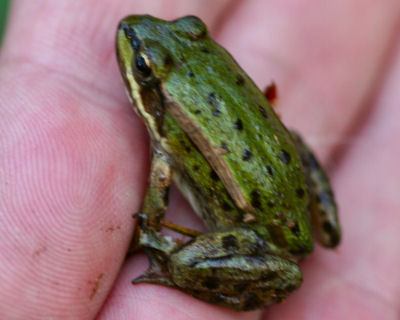
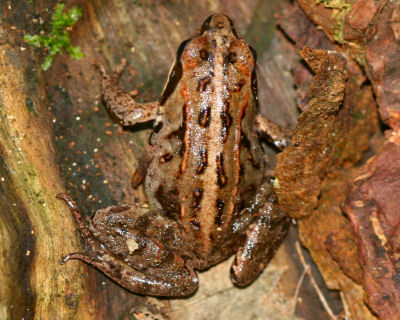
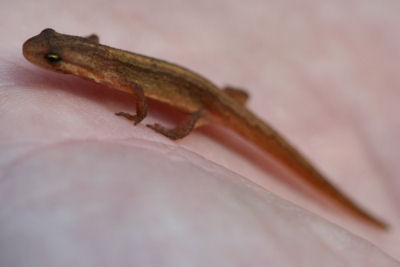
The newt we found, the Common Newt or Smooth Newt (Triturus vulgaris), is the most common, and often the only, newt in most of Europe.
After our outing at the Kieshofer Moor we both wanted to keep birding but weren’t sure where to go. Hendrik suggested a return to Karrendorfer Wiesen where we had birded with great success the day before to see if we could get looks at Bearded Reedlings, which we had only heard the day before, and to try to track down a Common Kingfisher, which was regular there according to Hendrik, though we had missed it on our previous visit. I was game so we cruised over to the now-familiar preserve and got to birding.
When we arrived at the pond where the Common Kingfisher was supposed to be we didn’t see anything at first. Then a small bird flew with stiff, shallow wing beats, like a Spotted Sandpiper, away from us, and when I got it in my bins its back was blue! A kingfisher! It even obliged by perching on a dead snag and letting me get the scope on it to admire its pink belly and electric blue back. What a bird! It was such a good bird, in fact, that I couldn’t stop looking at it. When I finally yielded the scope to Hendrik the bird flew as soon as he got his eye on it. I’m just glad Hendrik sees them pretty darn often or he might have thrown me in the pond!
We continued our birding, stopping to scan the bay but not seeing anything different from the day before. We also continuously listened and looked for those elusive Bearded Reedlings, and, though we heard them on several occasions, had no luck seeing them. We did not, however, have a hard time finding cows.
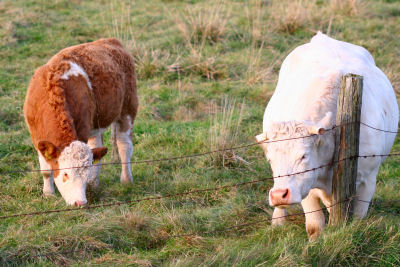
the cows didn’t see any Bearded Reedlings either
When we reached the mudflats Hendrik scoped for shorebirds while I focused on the other side of the trail, looking down a channel in the reeds hoping to see some Bearded Reedlings crossing it. I failed in that endeavor but did get great looks at a Water Rail! And got Hendrik on it! It sure made me happy as now I don’t have to worry about whether or not I could count the lousy look I might have had of one the day before. And, while I was happy to have seen a Water Rail I must admit that if I had seen the same bird on Long Island I would have assumed it was a Clapper Rail and if it was in upstate New York I would have thought it was a Virginia Rail.
We didn’t see anything else that we hadn’t seen the day before, though Hendrik did find a couple of Ruff that were much closer and I enjoyed great looks at birds that I will only see in the U.S. with great luck or by twitching them.
After that we had a great dinner (schnitzel and beer is a great combination) and an early bedtime, as we were birding again in the morning!







Is Water Rail a Salt Marsh bird or a fresh water bird? Clapper Rails are almost strictly salt and Virginia are almost strictly fresh… So your comparison confused me… Which given the way the rest of my day has gone is not surprising.
I forbid you from seeing any good birds on Thursday, I’ve been trapped and haven’t gotten out… At the very least save a few for me!
Water Rail is mainly freshwater, but they’re migrants too so do turn up almost anywhere there’s water
@Will: I’m just saying that the rails I mentioned all look pretty similar, though there are obvious differences if one actually studies the field guide.
The Baltic Sea is not very salty as it is almost completely cut off from the North Sea / Atlantic and a huge amount of very large (freshwater) rivers run into it. I am sure you could even safely drink its water up North in Finland. As we are close to the opening of the Baltic to the North Sea, we have some salt (brackish water), but to most birds that little bit doesn’t really count.
So even if we get a Water Rail – which as Charlie mentioned is rather freshwater orientated – at the coast, it isn’t really coastal in an ecologic way.
Hi, That green frog looks like a pool frog, Rana lessonae.
@Donald & Corey:
how did I miss the frogs? Geez…
Okay, here goes. The brown frog on the lower picture might very well be a Moor Frog, Rana arvalis. This is to be expected at a place like Kieshofer Moor, and the species is the more common of the two “brown frog” species. A head shot in profile would be more useful, but I am quite confident.
The green frog is very difficult to identify from the picture, as the situation is very complex in central Europe (and elsewhere). There are two “true” species, the Pool Frog (formerly Rana, now Pelophylax lessonae) and the Marsh Frog (P. ridibundus – just like the “Laughing” Black-headed Gull 😉 ). They hybridize freely and the hybrids are fertile, and indeed the very vast majority of “green frogs” in Germany are these hybrids, called “Edible Frog” (P. kl. esculentus, kl. = klepton for “stolen”). The hybrids normally need to “back-cross” once in a while with one parent species to maintain their hybrid population (female hybrid with male of pure species), and many populations of Edible Frogs also contain one of the original species to a usually lesser extend. However, certain mutations allow Edible Frogs to pair only with themselves and still produce fertile offspring (albeit at a less “successful” rate), so there are also many populations that only consist of the hybrid Edible Frogs, with no “parent species” present.
Okay, so much for an introduction. I am quite sure Donald is aware of all this but Corey might find it sort of interesting. And besides, even if he doesn’t, he has YCNH on his life list while I don’t, so it feels good to teach him a lesson or two once in a while.
Now, to the frog on the picture. As I said, it is very difficult to tell as the most reliable character – for whatever reason – to separate pure Pool from Edible frogs is the so-called Callus internus, a callous elevation at the heel of the frog’s hind legs, situated at the base of its big toe. There are other characters as well, especially for identifying male Pool frogs, but the Callus internus seems to be the most reliable one. Now, the frog on the pic is definitely not a male Pool frog. However, it might be a female Pool frog or – much more likely – an Edible frog. Pro-female Pool are the shortish legs and the limited amount of spots on the back. Not so good for female Pool is the lack of a paler green back stripe along its spine, the rather darkish blue-green (rather than warmer yellow-green) colouration particularly on its head, and the dark green legs with large dark spots.
So my gut feeling is that it’s an Edible Frog.
This is also in accordance with the known distribution of the different “green frog” forms in this part of Germany, Mecklenburg-Vorpommern. Of course, much remains to be discovered as no-one really cared too much about the green frogs in the past (with their identification being so difficult). Keeping that in mind, the Pool Frog is only known from the far south-east of the region, with the closest known occurence around 30 kms to the south. now, that’s not too far, but the surroundings of Greifswald are covered quite thoroughly by herpetologists due to the city’s university, so I would expect a potential population of Pool frogs would have been discovered by now. Marsh Frogs are virtually unknown in this part of Germany, with only a small area occupied on the island of Usedom. This leaves us with Edible frog as the most likely candidate by distribution, and it seems probable that the hybrid population there has closer genetic ties to Pool Frog than to Marsh Frog.
That’s as far as I can go with the frogs.
And you are correct about the Newt.