Blue Crane, South Africa’s National Bird
By Charlie • July 15, 2008 • 11 commentsBlue Crane Anthropoides paradisea
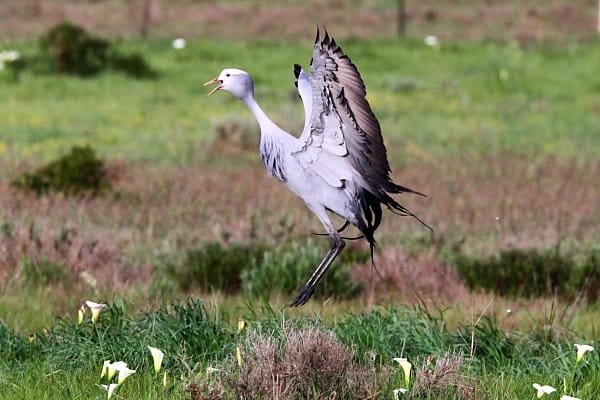
Agulhas Plains, Cape Province, South Africa. April.
One of the smallest of the 15 crane species worldwide the Vulnerable Blue Crane is the national bird of South Africa. It’s endemic to southern Africa, with more than 99% of the population occurring within South Africa (a small disjunct breeding population of approximately 60 individuals exists in northern Namibia, in and around Etosha Pan).
The Blue Crane is a bird of dry grasslands and other upland habitats rather than specifically restricted to large wetlands like most cranes. They are sometimes found in large flocks in open pastures in Drakensberg foothills, grassy Karoo, Western Cape wheatlands - similar habitat to where these photos were taken on the Agulhas Plains - and on the grasslands within and north of Etosha National Park, Namibia. (There were at least twenty birds strung out across the large field where the first birds in the series below were photographed.)
To quote from the excellent Saving Cranes website threats to the Blue Crane include, “Poisoning, habitat alteration, and power line collisions…Poisoning occurs both intentionally and inadvertently. Loss of grasslands to agriculture, urbanization/ecotourism developments, and commercial afforestation of South Africa’s natural grasslands are major threats to Blue Crane habitat. Grasslands are being converted to pine and eucalyptus plantations for pulp and timber production. Such plantings drastically alter the entire ecosystem; grassland vegetation is removed and water runoff and groundwater flow is greatly altered, leading to the desiccation of wetlands. Blue Cranes are especially vulnerable to collision with powerlines near roosting and breeding sites.”


The two (wary) adults with the nearly full-grown juvenile (below) were photographed in a different area to the birds above and were on their own. I originally saw them at a distance of about 400 metres, but hoped that if I parked up and sat quietly in the car for a while they may come closer. Over about an hour the group wandered to within about 80-100 metres before slowly wandering back to the far end of the field - leaving this birder with the memory of some great views and the good feeling that comes from seeing a rare bird with the next generation in tow!


All photographs copyright Charlie Moores
• Looking for a good book or field guide? We've got some suggestions... •


Dear Charlie,
These crane photographs are awesome. I am from the Endangered Wildlife Trust - The South African Crane Working Group. I was wondering if you could possibly send me these photo’s in hi resolution to perhaps use in our monthly newsletter and obviously you will be credited.
I look forward to hearing from you.
Regards
Debbie Thiart
They do look vulnerable…. and elegant ….and sad somehow. Did you also feel that way?
Wow Charlie - those are great shots. They are a bit odd looking - huge heads for cranes - but they are also very elegant in color and plumage. And you showed them well. And - a first to me - a young one!
Good work!
Cheers, Klaus
Debbie: I’d be absolutely delighted to help in any way I can. I’ll mail you asap.
Ambika: you know, you’re right. I think seeing threatened birds which - even in the wild - seem to be always on their guard does make me feel sad. Not to over-anthropomorphicise as nearly all birds have to look out for predators, but I would give anything for birds like these to be able to feel more safe. Sadly while we’re arund I don’t suppose it will ever happen…
Klaus: high praise indeed from such a great photographer - thanks!
Turning grasslands into tree farms seems insane. At least when they turned the American prairies into farms it fulfilled a basic human need: Food.
Nice photos, by the way
Jack Cowan
St. Louis, Mo.
Hi Charlie
Great images, I must say! I would appreciate very much, Charlie if you could give some insight on your site/ mail on what is the kind of photo equipment that you use. I am looking to invest in some lenses for wildlife especially birds and need some advice.
Regards,
Rohit
Sudan.
Wonderful! I love these cranes, have phograped them at Etosha NP, even with a tiny chick (under dad’s tail feathers! Annemarie
Dear Charlie,
These are great images and the birds look very fragile,if i may use the term. A colleague at work once came to my desk and wrote this question “South Africa’s national Bird? I didnt know, so he wrote again- The Blue Crane, Anthropoides paradisea and now I’m glad i can look at real images. Thanks for the great work you are doing.
Regards,
Martha,
Kenya
Once again, thanks everyone for all the positive comments. They are fantastic birds aren’t they, and if posting photos here demonstrates that then I’m happy to have been of service!
Martha, thanks for the work YOU’RE doing! I think though there’s a real opportunity here for ‘unqualified’ bloggers with a conservation passion like ours to work with professional naturalists and researchers like yourself. There are some positive developments behind the scenes with the Sharpe’s Longclaw project we’ll be announcing soon, and I’m feeling very positive that 10,000 Birds will be supporting far more initiatives in the future. Together we’re a lot stronger than we think, eh!
Great shots Thanks for sharing
You do lead a charmed life Keep on keeping on
Hi Charlie
Great Photos. I work on the species in this area. There were two things that struck me about the photos, the first been the age of the chick and the second the recently tilled land. The farmers usually begin getting the lands ready for sowing in late April, early May. You will note that the chick has not lost its “red” head. This together with the comparative size of the chick to the adults, I estimate that it is about 4-5 weeks old. Put the two pieces of information together and one realises that this is either a late breeding attempt or it is a second clutch from the same pair due to a failure of the first clutch. During this time of the year the birds are getting together to form large over-wintering flocks and the adults are introducing the fledged chciks to the flocks. Next time you are in South Africa try and get to the area durying August. The blue grey colour of the bird really looks great against the greens of the wheat, barley, oats lucern and dryland pastures.
Regards
Kevin