

When climate changes, causing habitats to move, birds can get up and fly away to a new habitat, so really, they’ll be fine. Right?
Well, that’s probably a little bit true, but only a very little bit. I’ve been working on climate change lately (not causing it, but reading and writing about it) and birds have come up in a few places. I’d like to take a moment to touch on a few disparate aspects of the relationship between climate change and birds.
Climate Change Velocity and Birds
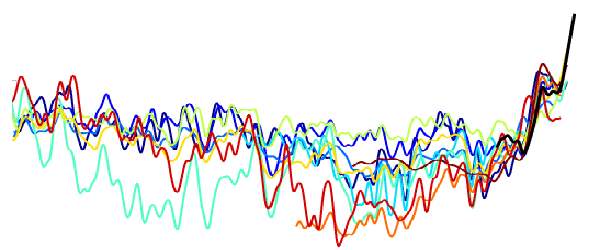
Climate change velocity is an interest of mine from way back, although people who study these things seem to have only recently discovered it and named it. Long ago I preached the idea that rapid climate change was more important (in a negaive way) than large climate change, and suggested that the Holocene was different from earlier time periods (and thus, for instance, humans invented agriculture and large areas of forest developed, etc.) because the Holocene had little rapid climate change. Then, as often happens, a PhD student (one of mine) by the name of Rusty Low came along and proved that the Holocene was full of all sorts of rapid climate change thus killing my beautiful hypothesis with a bunch of ugly facts. But still, there is variation in variation and how rapid climate change occurs can matter, as demonstrated in a paper just published in Science: The Influence of Late Quaternary Climate-Change Velocity on Species Endemism. This paper shows, among other tings, that birds that don’t migrate much or that have small species ranges are more vulnerable during rapid climate change than other birds. Also, for reasons I will not go into here, certain regions of the world are friendlier to birds during rapid climate change than others (like, for instance, Africa, generally).
Sea Level Rise
This relates to another old project of mine where, buried in some contract archaeology reports, I was able to show that during rapid periods of sea level rise in New England, coastal ecosystems were species poor and somewhat fragile because they lacked many different trophic levels and other ecological connections. A lot of this has to do with the fact that as sea level rises, marshlands, which are the the basis for a lot of fish and bird ecology, are wiped out, but if sea level remains stable for a while, or changes only slowly, coastal marshes have time to form. Imagine a world where suddenly, everywhere, all marine coastal region including estuaries had only 10% of the marsh grass and shallow marshland that they do now. This is not hard to imagine because humans have wiped out most of the marshland in certain developed areas and we can see what happens there … you get seagulls and pigeons, or their equivalent, and little else. Similar things happen to both fish and birds. Species diversity drops and the systems become very simple and uninteresting, and probably not very stable.
We have not observed sea level rise to a great degree with climate change, but it is about to happen. Over the next 20 or 30 years there will likely be some dramatic events along these lines. Keep watching. And roll your pants up.
Another aspect of sea level rise that will be interesting is the basic nature of the shape of the coast lines vis-a-vis bird ecology. For example, the Gulf Coast of the US is marshy and has a giant delta and lots of barrier islands, but the coast of the Maritimes and Maine don’t. There are a number of reasons for that, but the main overarching reason is chance; It just happens that certain climates (sub tropical vs. temperate) and certain shoreline configurations, coincide (or not). The eastern Yucatan and the corresponding regions (with respect to sea and air temperature) of western Mexico and Central America are very different in their geological configuration and other features. The coast of California is high and cliffy and there are no barrier spits, while the East Coast of the US is low and marshy with sandy barrier islands. And so on. Every coast and climate confluence around the world is (mostly) a product of random associations between geology and regional climate.
Well, imagine raising the sea level 20 meters (and yes, that is more than a little bit possible). The geology along which the coast nestles will be different than it is now in many regions. Not only will the coast line move, but it will fundamentally change in ways that matter to the birds that live in those vital habitats.
Penguin: Is their goose cooked?
Penguins have already been taking it in the neck in places where shore-line shelves of ice have broken up or moved around in the antarctic. Penguins can be trapped in low areas created by breaking up ice. Their nesting ground can be destroyed. Their food supply can be affected. So far, the Penguins on Ross Island have not done very well. Almost all of the Adélie Penguins there are gone, and the Emperor Penguins there are now extinct, all because of global warming related changes. With global warming, we might expect a lot of the ice around the margin of Antarctica to disappear (though there will presumably be winter snows). We can expect most of the Antarctic Penguins to either go extinct or become very vulnerable. And, in that region, Penguins are a keystone species for some of the other birds.
Global warming, a major part of climate change, matters to birds, has already mattered to birds, and will likely matter a great deal more over the next century.








I don’t understand your use of keystone species here. I thought a KS was a top predator-wolf or shark. What do you mean
by ” KS for some other birds”?
Good question.
A keystone species is not a top predator, but rather, a “key” species in an ecological system. For instance, in large area of Africa, Aardvark is a keystone because it is one of the only (maybe the only) mammalian (or reptilian?) species that digs appreciable holes. Anything else that lives in holes needs to find them (then perhaps modify them somewhat) and in vast regions all the holes are made by Aardvarks. If you got rid of Aardvarks, there would be no denning, and all denning species of mammals would be at risk, and anything they affected would be at risk. So, for instance, in Aardvark-only hole regions Hyenas would suddenly be at a disadvantage vis-a-vis lions, for that reason lone (lions don’t den) and that would have consequences down the line to the prey species, the plants the prey eat, etc.
Penguins are a keystone species in the Antarctic because they provide most of the food for birds that eat baby penguins (or eggs).
In New Mexico, Black-tailed Prairie dogs could be considered a Keystone Species: their towns and colonies alter and maintain vegetation communities, provide habitat for grasshoppers, ants, wintering sparrows and other passerines, they provide structures (burrows), low/open vegetation and a prey base for other species/taxa such as Horned Larks, Prairie rattlesnakes, Burrowing owls, Ferruginous hawks, and Aplomado falcons. Without them these systems basically collapse.
Another link between birds and climate change is the timing of migrations and the shifting of ranges (which you have probably covered somewhere, but I don’t remember seeing it). All this recent denialist noise about the Berkeley reports and the interpretation of temperature data looks really silly when we ask the birds (and butterflies and wildflowers) what they think about climate change. We have good records of dates of migration of birds, first flowerings of wildflowers, etc, going back at least a century. These data are reasonable proxies for temperature (though other things like precipitation are also influential in some areas), and they may well be better measures of mean climate than the instrumental data of a century ago. This biological data is unequivocally supportive of a steady increase in mean temperature over the years. Birds are nonpartisan and neither liberal nor conservative; they have to get this right or they die, and they unanimously judge that the climate is warming . I wish climate-change denialists had to demonstrate the same level of commitment to their claims; I bet they would be a lot more honest and careful.
Of course the birds don’t show whether this change is anthropogenic or natural, but my point is that there can be no debate about the fact of global warming.
In Europe estuarine marshes have been gradually drained over the past couple of millenia. It will become increasingly difficult to keep them drained as sea level rises, so I can see a comeback for marsh species.
My understanding is that barrier islands migrate with changes in sea level. Would they be able to keep up with the projected change in sea level over the next century or two? Of course, roads and buildings on barrier islands will slow down their migration a little.
The discussion on keystone species was pretty interesting. I am trying to figure out which is the keystone species in my study area where I could find leopards, clouded leopards, jungle cat, leopard cat, black bears, jackals, squirrels, porcupines, barking deer, himalayan serow, civets, martens. Hahahaha.. I got it, nothing is easy as it seems!