
 While green is rather common color in avian plumage, it rarely attains the flamboyance of a parrot’s chartreuse or the emerald of a hummingbird. More birds are adorned in more practical, which is to say muted tones. One rather colorful name for a stock yet sober shade of green is OLIVACEOUS. Olivaceous means just what you probably think it does: of or like the olive. The olive in question is, of course, the magical fruit of the Olive Tree (Olea europaea). Olivaceous describes not the stygian purple depths of the olive at full maturity but the striking yellow-green of the unripened drupe.
Olivaceous presents a subtle sophistication absent in more gaudy greens. It certainly looks good on birds from the Americas (Elaenia, Flatbill, Greenlet, Piculet, Piha, Siskin, Thornbill) to Africa (Flycatcher, Thrush). The Old World’s Olivaceous Warbler is a dapper example of how drab this shade can be, while the Olivaceous Woodcreeper of Mexico and Central and South America dazzles in silvery green and flaming rufous. North America’s most famous olivaceous avian, Vireo olivaceus is better known for the color of its eyes than that of its plumage.
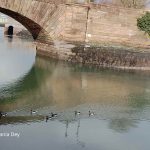
Aficionados may find it amusing that the New World bird most commonly attributed at one time with olivaceousness is now more aptly associated with its Neotropical environs…
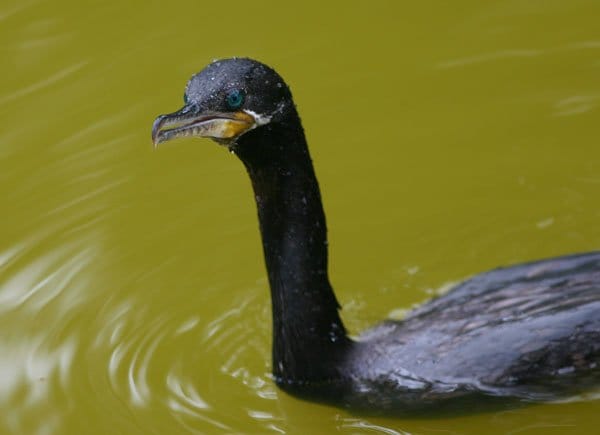
Neotropic Cormorant in olivaceous water
Plainspoken folk eschew the ostentatious olivaceous for the more modest OLIVE. Ornithologists have anointed a Bulbul, Bushshrike, Finch, Flycatcher, Flyrobin, Honeyeater, Ibis, Long-tailed Cuckoo, Manakin, Sparrow, Spinetail, Straightbill, Sunbird, Tanager, Thrush, Warbler, Whistler, and Woodpecker with the olive appellation. That doesn’t even cover the birds named for their olive backs, bellies, caps, chests, crowns, flanks, heads, rumps, shoulders, sides, spots, streaks, stripes, tails, throats, and wings. In an interesting turn of events, while there are a multitude of birds from euphonias to woodpeckers named for their olive backs, there are also birds simply named Olivebacks, three alluring estrildid or estrildine finches in the genus Nesocharis.
Apparently, in some instances, olive isn’t an accurate enough description. How else could one explain an Olive-brown Oriole, Olive-green Tyrannulet, or Olive-yellow Robin? How about the Bronze-olive Pygmy-Tyrant, Golden-olive Woodpecker, Pale-olive Greenbul, or Grey-olive Greenbul?
Olive must favor greenbuls; not only do we have the aforementioned olive greenbuls, but we’re also blessed with Olive-Greenbuls in both Toro and Cameroon. Cameroon boasts Olive-pigeons as well, as does Sao Tome, Comoro, and greater Africa. The light on that continent must be flattering to plumage of this particular hue because Africa is also the home of the Olive-Sunbird, sometimes split into Eastern Olive-Sunbird (Nectarinia olivacea) and Western Olive-Sunbird (Nectarinia obscura).
Any discussion of olivaceous avians would be incomplete without the inclusion of the Olive-tree Warbler (Hippolais olivetorum). This Old World warbler, which winters where else but Africa, is named not for its dusky gray plumage but rather for its affection for olive groves. The attraction is obvious.
*This post was originally published in November 2007, but we hate to keep posts this good buried in the archives.






It’s just fun to say “olivaceous.”
Almost as much fun as saying “unripened drupe.”
Happy Thanksgiving to the 10,000 Birds crew, even those that may not celebrate it.
Any idea why the “Olivaceous” Cormorant (now usually lumped with Neotropic) was given the name? They’re not green.
I always thought Olivaceous Corm was so named because they are kinda green iridescent sheeny on the back in the summer. I imagine it’s one of those things that’s more obvious in the hand, like the ring-neck on the Duck and red-belly on the Woodpecker. I agree with you, they don’t look much green at all to me.
That misnomer is probably why they moved to the Neotropics… that and the fantastic weather.