

Years ago, Charlie Moores coined the colorful term “manky mallard” to describe the motley menagerie of feral and domestic mallards (If you’re wondering, manky means many things in British parlance from dirty and disgusting to inferior and worthless.) Here at 10,000 Birds, we’ve always celebrated odd ducks, which means manky mallards feel right at home!
How varied are the forms of Anas platyrhynchos? You’d be surprised. You might first consider the mallard complex and the unseemly hullabaloo of hybrid mallards. However, the malleability of the mallard gene really shines through the dazzling diversity of domestic mallards…
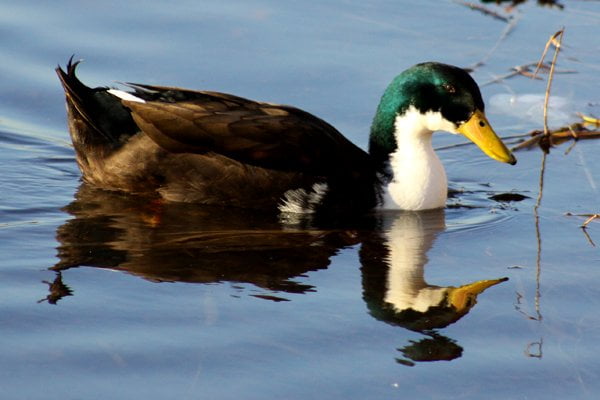
What are the different breeds of domestic duck?
ABACOT RANGER
Abacot Ranger or Streicher ducks are often referred to as hooded rangers because of the buff feathering of the hen’s head. The ranger drake sports a brown cowl as well as a dappled chestnut chest. Both have white bodies.
ANCONA
Ancona ducks are among the mankiest of the domestic ducks with mottled monochromatic plumage. Anconas forage actively despite their flightlessness.
AYLESBURY
The Aylesbury duck was the original white farm duck of Europe, before the Pekin toppled it from its lofty perch. Aylesbury birds are pure white with orange legs, but distinguished from Pekins by their pink bills.
BUFF ORPINGTON or BUFF
Buff Orpington ducks are drab ducks named for the buffy coloration of the females. The male has a brown hood and buff body. Buff Orpington also describes a breed of barnyard chicken.
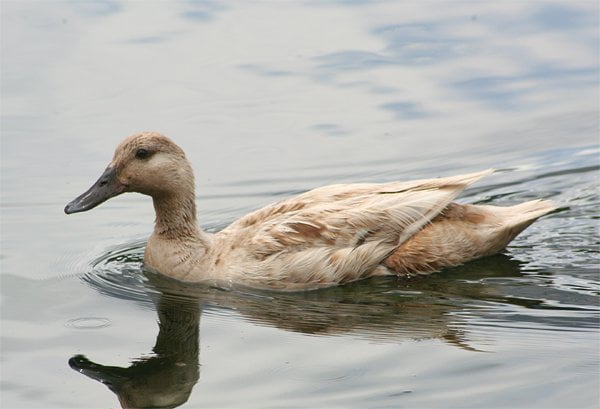
female Buff Orpington in Salida, CO © Miles Groth
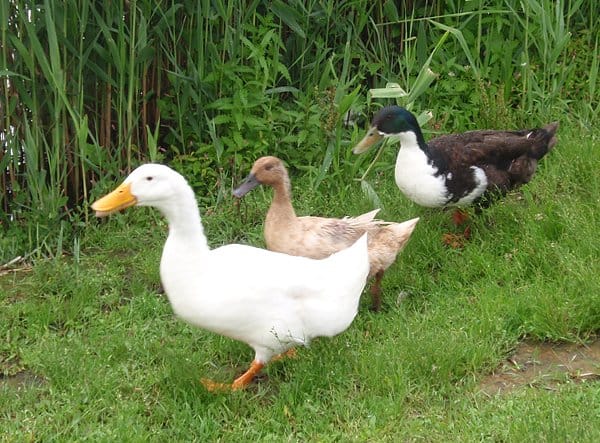
Probable Buff Orpington hen flanked by a Ganky Goose and Duclair drake
Manky mixed flock in NY © Jay Richmond
CALL
Call ducks are quite compact, smaller than any other domestic and wild mallards. Thanks to their modest proportions, these mini-mallards are better flyers than other mankies.
CAYUGA
The Cayuga duck takes the striking metallic green plumage of a wild mallard drake’s cowl and wears it from tip to tail. In fact, Cayuga males and females both flaunt this dramatic feathering. Interestingly, the entire breed of black ducks, as Cayugas are called, can be traced to a single pair raised in Duchess County, NY.
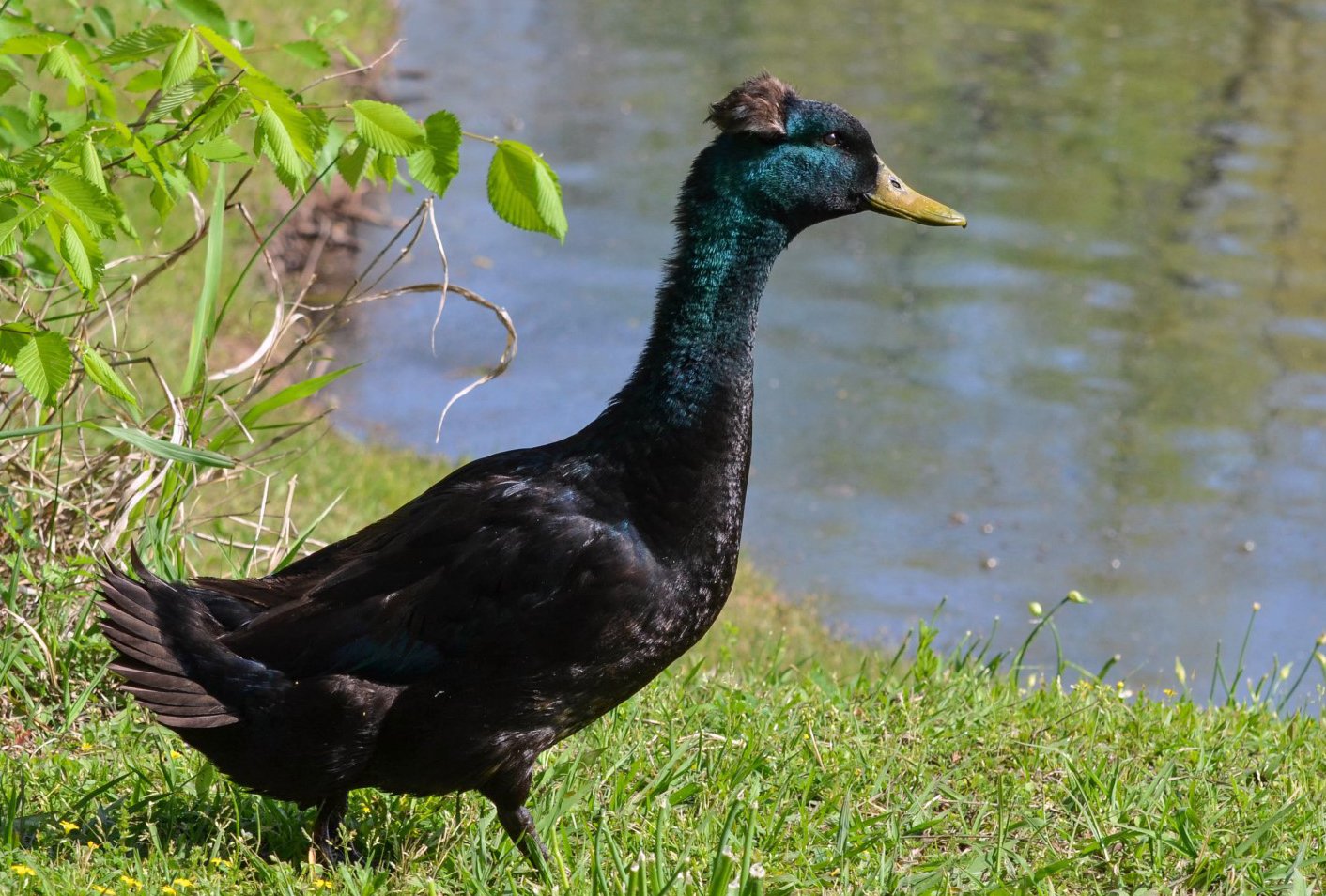 Crested Cayuga from Dallas/Ft. Worth © Lisette Lebaillif
DUCLAIR
Duclair ducks are classic manky Mallards with green heads, white bibs, and solid brown, black, or even blue-gray bodies. The distinction between Duclairs and the rarer Pommeranians is lost on me.
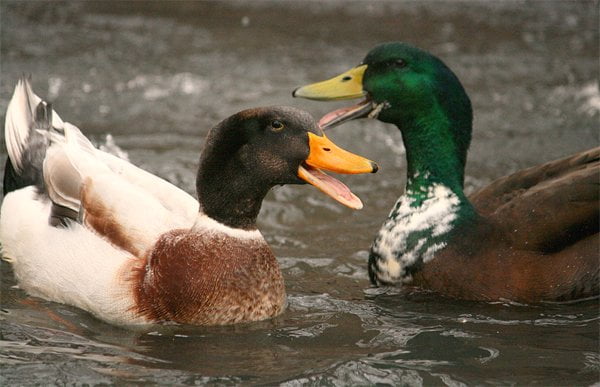
Brownie and Greenie, probably an Abacot Ranger and a Duclair © Bonnie Shulman
INDIAN RUNNERS or RUNNERS
Indian Runners appear attenuated, as if someone stretched a regular duck on a rack. These upright feathered bowling pins come in a variety of colors.
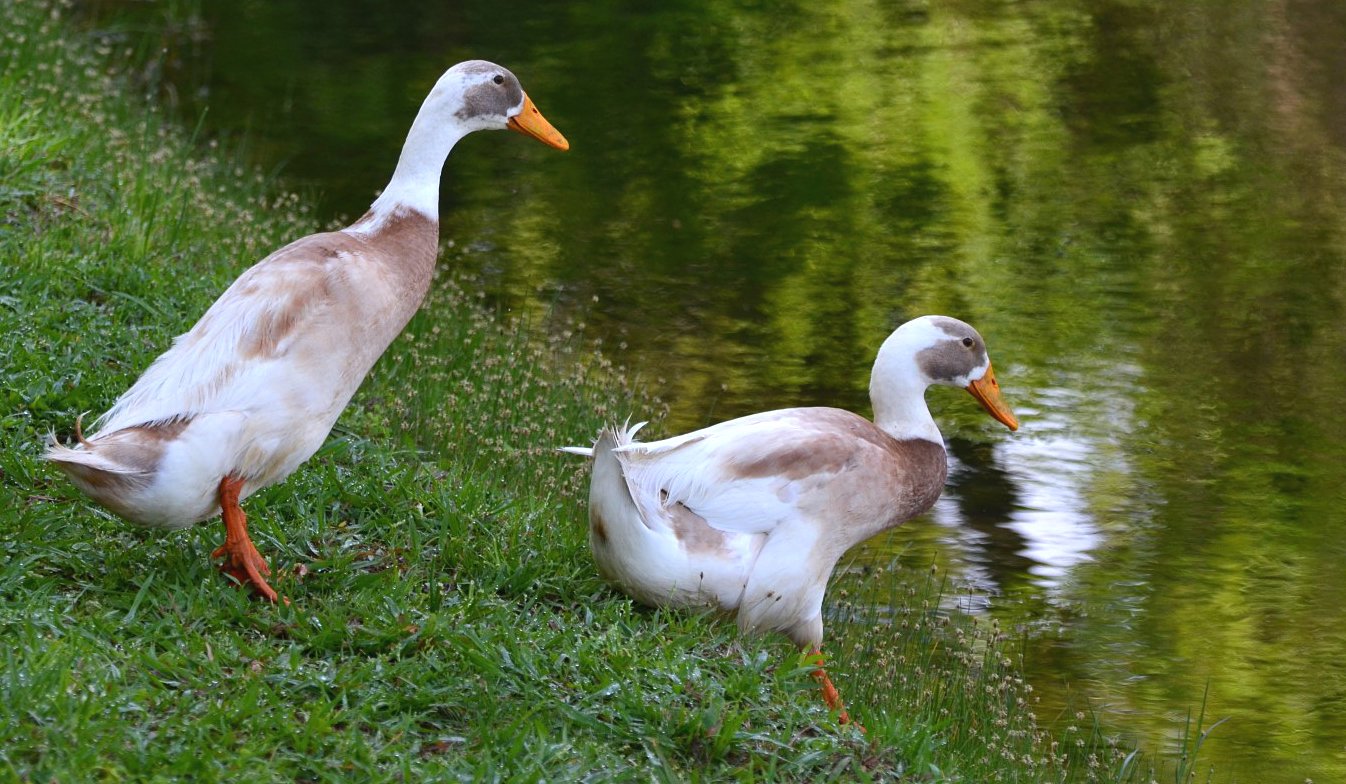 Indian Runners © Lisette Lebaillif
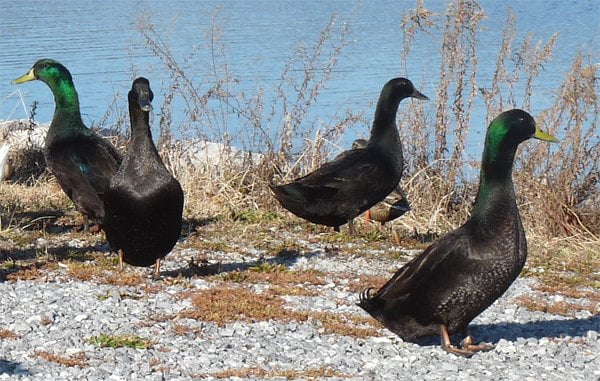
These lovelies look like Black Indian Runner x Cayuga. Photo © Karen Davis
KHAKI CAMPBELL
Khaki Campbell ducks, named for both their primary color and the original breeder, bear a superficial resemblance to wild Mallards. However, their oddly-shaped, heavy bodies and drab plumage give them away. Females have distinctive dark heads and bills.
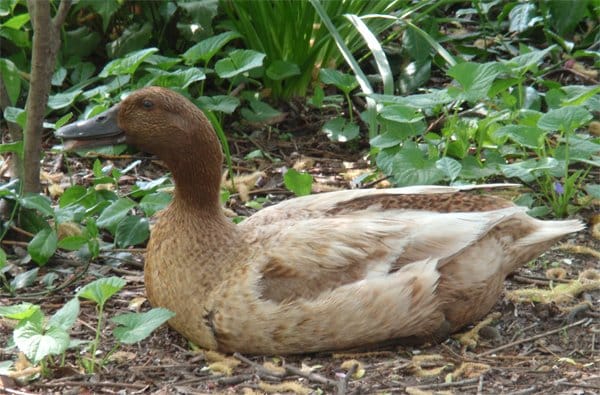
Khaki Campbell Hen in Central Park © Jay Richmond
MAGPIE
Magpie ducks , much like actual magpies, make the scene in brilliant black and white, although variations exisit. Magpies are distinguished from Anconas by their more predictable patterning, which includes a smart black tonsure. Magpie ducks don’t bulk up as much as many domestic breeds do.
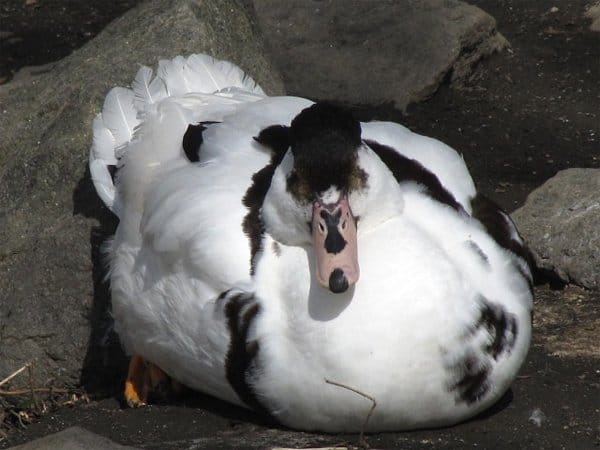
Magpie duck © Meredith Matthews
PEKIN DUCKS
Pekin ducks embody exactly what most people envision as the classic domesticated duck. These barnyard beauties have large pure white bodies with orange bills and feet.
ROUEN
Rouens look a lot like Mallards stuffed with more Mallards, which is to say they are much heavier than their wild kin. In fact, most Rouens can barely fly
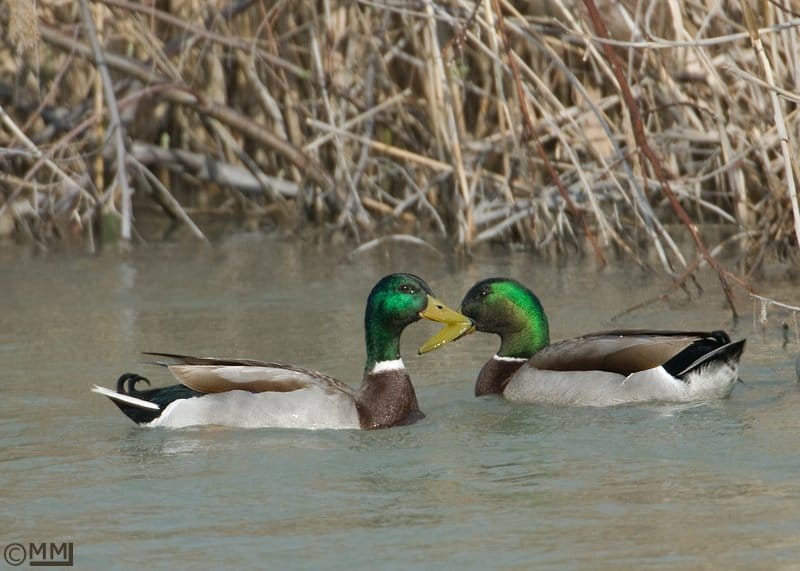
This photo © Mia McPherson of on the wing photography (used with permission) shows how a Rouen differs subtly from a wild Mallard: look for overall beefiness, a sloping forehead, and almost perfect plumage!
SAXONY
Saxony duck drakes look like large, faded wild Mallards but the females and young are far more fetching in their fawn-colored plumage with white facial markings.
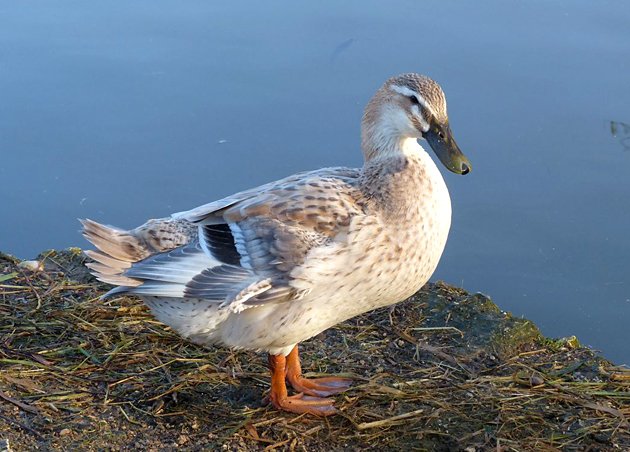 Sexy Saxony hen from the Grantham Canal at West Bridgford, Nottingham © Mike Fuller
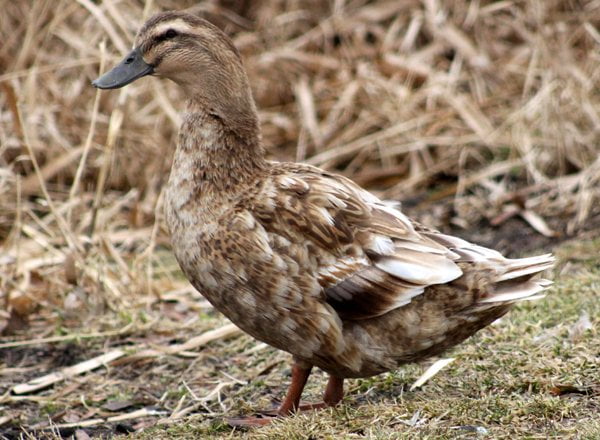
Looks like a Saxony hen © Corey Finger
SWEDISH
Swedish ducks are heavy bodied, bibbed birds that appear in different shades of blue, gray, and black.
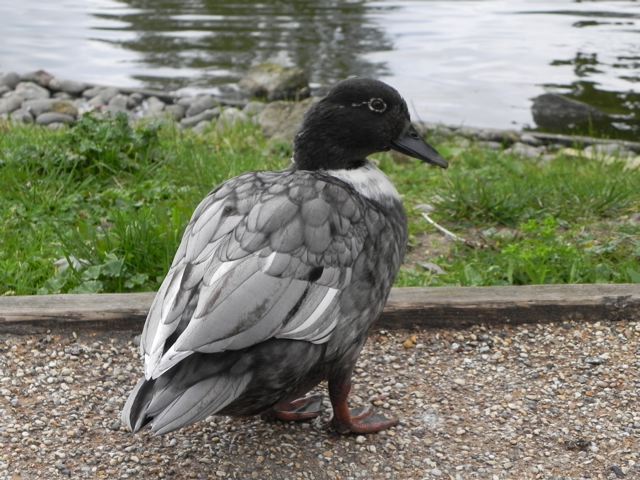
Blue Swedish (x Call?) duck at Slimbridge Wetland Centre in Gloucestershire (c) Mike Fuller
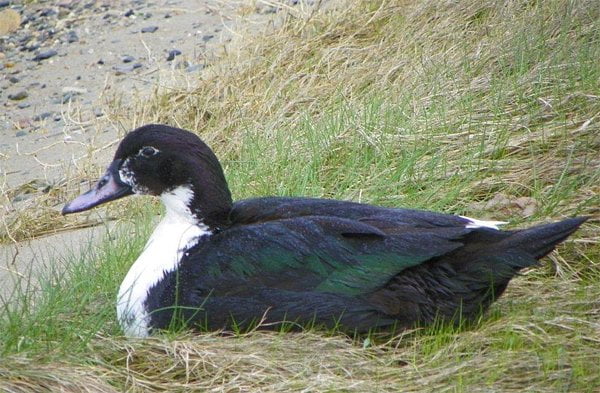
Black Swedish Duck at South River in Marshfield, MA © Mary Rittal
ARE CRESTED DUCKS A SEPARATE BREED?
One of the most fascinating finds when watching domestic ducks is the odd duck flaunting what appears to be a large powder puff, cotton ball, or afro on its head. These are called Crested Ducks and are sometimes considered their own manky breed. However, the crest is actually the manifestation of a mutation; the crest is formed from fatty tissue that seeps through a gap in the bird’s deformed skull. Sounds grisly, but the mutation clearly isn’t fatal, though it can lead to health and balance issues. At least it looks cool!
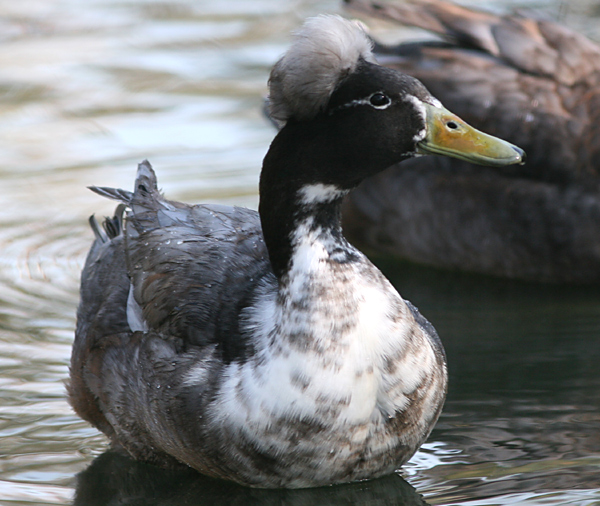
I spotted this Crested Blue Swedish duck at Kenneth Hahn State Recreation Area in Los Angeles.
Council Bluffs, Iowa must have something funny in its water, if these ducks are any indication:
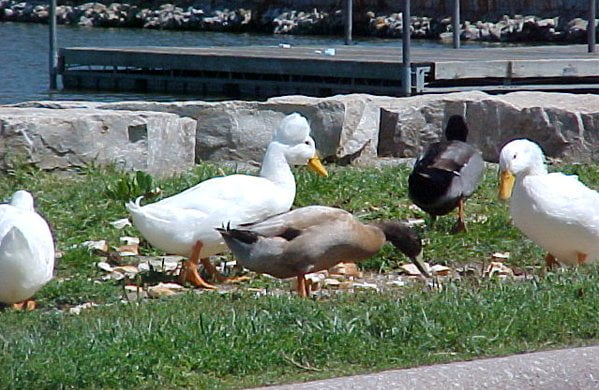
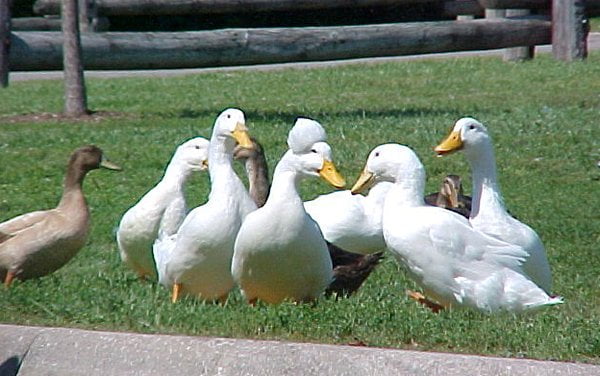 Pekins, Crested Pekins, and Khaki Campbell © Dan Hudson
Try to guess the breeds of the manky procession below. Scroll over the photo for the ID:
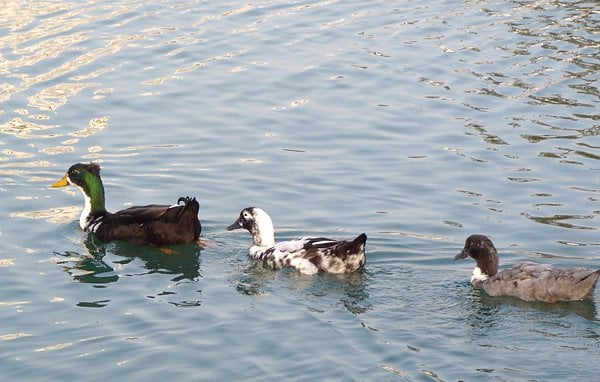
IS IT MANKY?
Just because a duck looks odd doesn’t mean it’s manky.
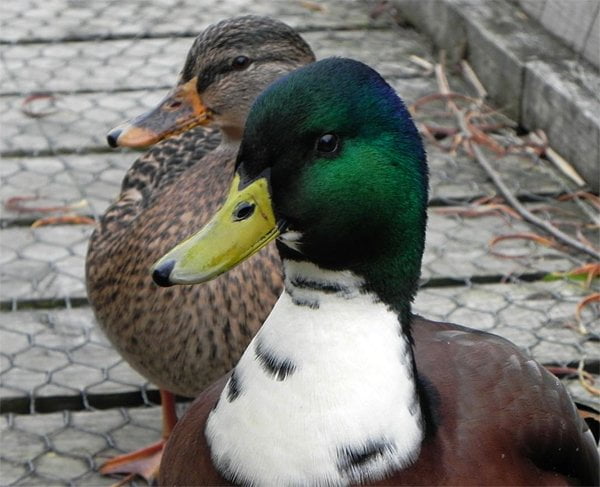
This Mallard, captured by Mike Fuller at the Arundel Wetland Centre in the UK, flaunts a bib. However, the bib alone doesn’t make the duck domestic as bibs do occur very rarely in wild Mallards. On the other hand, the drake’s bulk suggest a certain degree of mankiness.
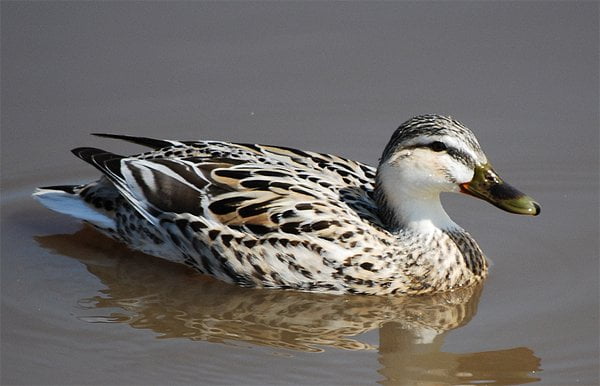
This striking female Mallard, snapped by Renee R at Richfield Lake in Richfield, MN, certainly stands out. But is she manky? She’s probably just leucistic, which means she has reduced pigmentation.
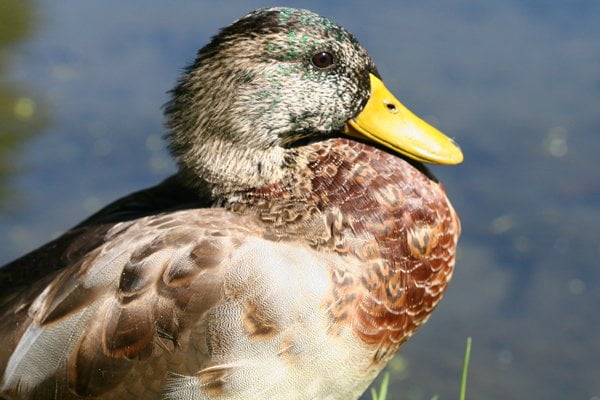
The faded fellow above, photographed by Corey, is a wild Mallard enduring a total eclipse of the plumage. Eclipse plumage is a phenomenon mostly associated with male ducks wherein they moult into a dull, female-like plumage once the breeding season is over.
ARE DUCKS BORN MANKY?
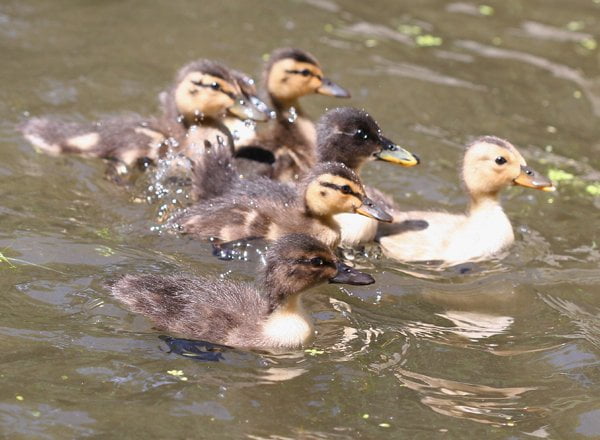
Manky mallards are most certainly born that way, as mankiness manifests from the breeding and interbreeding of domestic mallards. If you’re looking for proof, feast your eyes on Corey’s analysis of Mallard Ducklings: Manky and Not.
IS IT EVEN A MALLARD?
Not every odd duck at your local lake deserves to be dubbed manky. Some of these weird waterfowl aren’t even Mallards…
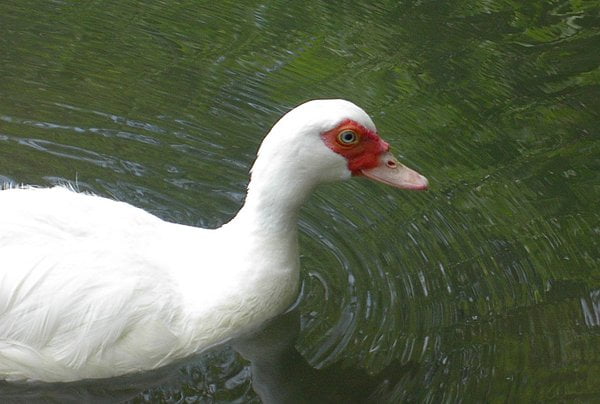
If you see a duck like this one I captured many years ago in New York’s Central Park, you’ve encountered not a Mallard, but a domestic Muscovy Duck. Manky Muscovies are another story entirely!
*** Have you seen any manky mallards lately? ***
If you have great photos of manky mallards you’d like us to add to this gallery, send them to mike AT 10000birds DOT com!


 New writers welcome – please contact us for details.
“What are the different species of domestic duck?”
Species Mike? Subsequent Muscovy reference notwithstanding surely breed/type would be more accurate.
Definitely, Tai. That was a big oversight on my part. Thanks for the correction!
PS – hit post before I’d finished and meant to add:
a) cool (and rather complete) post;
b) that leuc female is rather pretty; and
c) has that blue swedish cross got some hybrid in it. beak looks a bit wood ducky…
Mike, this is a lovely post, indeed. A small remark: the wild male on the third photo from above has a bit of a pale breast and lacks the white collar, so it might have some mankyness in it, too.
🙂
Thanks, Jochen. I see a bit of a collar on that bird, but see where you’re coming from. Don’t we all have a bit of mankiness in us? 🙂
Of course not, Mike. I may be odd, and singular, and different, and confused by gulls, but manky? 🙂
I saw two manky ones at NY Botanical Garden in Bronx a couple weeks ago. Those were cow color patterned (patchy black and white) and swimming with bunch of Mallards. If I had known that this article was coming, I would have kept my photos to send one to you, Mike!
Cow-patterned suggests the breed known as Magpie.
I see Manky Ducks all the time at Flushing Meadows Park. I didn’t know they had names. Thank you. Now, I can stop calling them ugly ducks and assuming they look weird from the polluted water. I’ll have to take a cheat sheet with me, that’s a lot of manky duck breeds!
Actually, Donna, Queens birds may well be mutants. The weird ones in the Bronx are manky…
Oh good, at first glance I thought you said Queens birders may be mutants. I would then have to put my New Jersey Audubon hat on.
i love ducks to be my pets since i was a kid i used to buy a dozen of ducklings…. i hope i could have different species specially the Mandarin.. soooo cutiiiiieeeee … ^_^
hi
i have a male black east indian/labrador duck, and a female cayuga, & wondered if it were possible for them to mate?! can a call duck sized male mount a good sized cayuga?
thanks!
beca
OK, I’ve got a problem. I have a pet duck, and I can’t figure out what type of breed/species/hybrid whatever he is.
at first I thought he might be a rouen, due to his mallard like appearance during the winter, but there’s a problem; rouens don’t go into the eclipse plumage from what I’ve heard…
and also, no matter what time of the year it is, he always retains some mottled brown plumage on his stomach, breast, and neck (completely mottled on the belly though) he also lacks the white neck ring and has a very green bill, not greenish yellow, but quite literally green, with a brownish tinge to it.
so basically, he has a mostly chestnut/rufous breast, grey wings coverts with a brown and black wash, brown primaries, grey-brown wings, purple/green-blue speculums, a mostly green head with brown flecks, a blackish brown tail, green black upper/undertail coverts and back, almost completely solid brown scapulars, grey flanks, brown eyebrows, and a mottled stomach. his legs are the typical orange color, and his bill is that weird gang-green color. he also has brown eyes. (not that it matters) during the summer months till about November, he looks almost exactly like a female mallard other than dark green-black feathers on his nape, crown, and a stripe running from his bill to well past the eye. also his tail and back never changes, nor his wings, speculums, or stomach.
he’s about 26 inches long bill to tail, and weighs about 15 pounds
one more thing, he’s about three or four years old too. I’m not sure if he’ll become more rouen like or stay the same…
so, does anybody know what kind of duck he is? and if so, how long he’ll live?
Beautiful pix!
Oh my god, i see soooooo many wrong things here, i dont know were to start!
1. http://10000birds.com/wp-content/uploads/2011/02/bufforpington.jpg
Answer: This is NOT a Orpington duck. I think its a cross.
Here are 100% pure Orpingtons: http://d1j96f25uhu3hg.cloudfront.net/images/breeds/ducks/orpington/pictures/Buff-Orpington-Ducks.jpg
2.http://10000birds.com/wp-content/uploads/2011/02/abacotswedishganky.jpg
Answer: The white one is not a goose! Its a duck! i think its a peking duck, white champell duck or aylesbury duck.
3. http://10000birds.com/wp-content/uploads/2011/02/brownieandgreenie.jpg
Answer: Its not an acobat ranger, its the colour apricot snowy and acobat rangers are just snowy (not apricot)
4. http://10000birds.com/wp-content/uploads/2011/02/magpieduck.jpg
Answer: This is a Muscovy hybrid, look at the pink bill!
5. http://10000birds.com/wp-content/uploads/2011/02/mallardswildandrouen1.jpg
Answer: Rouenducks are not so small! They are 3 times bigger than mallards! GOOGLE.
6. http://10000birds.com/wp-content/uploads/2013/02/saxonyhen1.jpg
Answer: NOT a Saxony! Here are a picture on a 100% pure saxony female: http://www.holderreadfarm.com/photogallery/saxony_page/Sx_Oct2806_N69.jpg
7. http://10000birds.com/wp-content/uploads/2010/09/slimbridgemysteryduck2.jpg
Answer: Not a blue swede, i think call duck x mallard or something like that. Its to small for swedish blue.
8. http://10000birds.com/wp-content/uploads/2011/02/mallardrittal.jpg
Answer: Again, Muscovy hybrid, look att the bill.
Thanx for sharing your outstanding illustrations above!
( ‘)>
so basically, he has a mostly chestnut/rufous breast, grey wings coverts with a brown and black wash, brown primaries, grey-brown wings, purple/green-blue speculums, a mostly green head with brown flecks, a blackish brown tail, green black upper/undertail coverts and back, almost completely solid brown scapulars, grey flanks, brown eyebrows, and a mottled stomach. his legs are the typical orange color, and his bill is that weird gang-green color.
http://www.meizu-mx5.com/
Thanx for sharing your outstanding article
Several of these photos and descriptions are incorrect. Sad to see that its still like this so many years after the article was made.
Would you mind sharing which ones you think are incorrect, Daniel?
I love this article. Entertaining and informative.
Hi Mike, I have several photos of Manky Mallards. I have given you a link to my website at the bottom of this comment. I presume that you give the photographer credit for theor pictures, if so would like to feature any of mine on your Manky Mallards website, if so et me know, which ones. Please provide a valid email address.
https://www.hattonsgarden.org.uk/species_urls/uk_birds/water_fowl/anatidae/anitidae_page2.htm
Hi. Another set of ducks dropped off at the park. One muscovy and a grey duck that looks like a largish mallard with blue swede mixed in, but appears much bluer than any blue swede I have seen before. Any suggestions?