

As long as the ivory-bill’s existence remains ambiguous, North America’s reigning woodpecker must be the Pileated Woodpecker. This hulking beauty, black and white with a preposterously scarlet crest, is a most pleasing presence across much of the United States and Canada. That crazy coiffure along with its whinnying laugh betray this bird’s claim to fame as the inspiration for Woody Woodpecker but if you catch sight of Dryocopus pileatus, you probably won’t be thinking of cartoons. Once you stop staring in wonderment (yes, these birds are that cool, especially against the gray of winter) you might ask yourself this question:
“How do you pronounce pileated?”
The word ‘pileated’ is connected to the biological term pileum, which is the top of a bird’s head, the area extending from the base of the bill to the nape. Pileum in turn derives from the Latin word pileus, meaning cap or, if you wish to be as specific, felt cap without a brim. I believe it is generally accepted that in ancient Rome, the word was spoken with a long ‘i’ like pie. However, in the 21st century, we reserve the right to veer from the old ways, especially when it feels right. There are at least two reasonable ways to pronounce pileated and I’d like to know which one you adopt.
This isn’t the first pronunciation poll presented on 10,000 Birds. Our Plover Pronunication Poll was quite entertaining, albeit inconclusive. If we’re lucky, we’ll have even more incisive comments and participation in this one. As an added bonus, we’ll also finally be able to confidently call Pileated Parrots, Antwrens, Flycatchers, and Finches in the field. Sweet!
[poll=3]
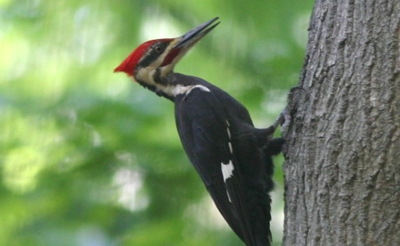
Just don’t call me late for dinner…








“I believe it is generally accepted that in ancient Rome, the word was spoken with a long ‘i’ like pie.”
I’m hesitant to claim any kind of authority, but I would have thought it was a long ‘i’ like pee. The use of the letter ‘i’ to indicate the diphthong sound in ‘pie’ is an unusual feature of English: in most languages it indicates an ‘ee’ sound. Think of Italian and Spanish. Even in Anglo-Saxon (i.e. before the C11th) it either indicated the vowel in ‘pit’ or the one in ‘peet’; it was only with the Great Vowel Shift in the later medieval period that the pronunciation of vowels in English got all messed up and out of sync with everyone else.
So ‘pileum’ would I think be something like pee-lay-um. Usual disclaimer: IANAL.
Not, of course, that we need to let our own pronunciation be dictated by Latin. FWIW, I’ve always said ‘PILL-ee-ated’, but I’m British and that was just what seemed like the obvious pronunciation when I first looked in an American bird guide.
I’m with Harry on this and not just because I’m also a Brit. Definitely “Pill-ee-ated” and it never occurred to me to say it any other way, even with my latin O-level from 1969. In those days I don’t recall the pronunciation being a major part of the course and if it was I have obviously forgotten!
Keep up the good work on this website. As a regular visitor to Florida and just starting to visit Canada this is one of my favorite sites to look at.
PS. Sorry forgot to say I would have voted but couldn’t find a link to a voting site.
Definitely PILL-ee-ay-tid for me.
In Latin, the letter ‘i’ is pronounced ‘ee’, so an etymologically correct pronunciation would stick closely to that.
Well, good point BUT …
The latin word “pileum” wasn’t used in its original latin version when naming the Woodpecker but transferred into English by applying English grammar to it:
PileATED.
The English language has borrowed many, many words from Latin and surely doesn’t pronounce all of them like the good old Romans did.
So why this one?
If we presented the word “Pileated” to a crowd of non-birders, how would they – having never seen or heard it before – pronounce it?
I bet there would be a Pile of Pileateds and not even a small Pill of Pileateds…
Would you believe that I took two years of Latin? Clearly, I should have hit the books before bring my case to the public!
Is PEE-leated even an option for pronunciation?
Pill ee ay tid. It never occurred to pronounce it any other way.
Why not take the Cornell expert’s word? Great article here:
http://www.birds.cornell.edu/crows/birdname.htm
I’ve always said “pill.”
This article http://mexicobirding.com/about/pronounced_burd.pdf was posted by one of its authors in the SE AZ listserve when the apparently resident Northern Jacana (zah – sah – NAH) was discovered down there recently. It looks very similar to the article posted by Suzanne, though, so you may not want to read both. Or maybe you do!
We say PILL over here, but they are both correct…I say potato and you say potahtoh…couldn’t resist!
Cool to do a poll on this!
Boiders,
Cornell expert agrees with English’s orthography’s attempt to be “phonetic”:
What do we already know by analogy? First, see this list of analogues:
mile and mill
bile and bill
file and fill
In sum, here’s the orthographic rule (more or less–can’t say I’m willing to waste any more time on such trivial matters):
vowel followed by a single consonant = so-called long vowel
vowell followed by a doubled consonant = so-called short vowel
BB
P.S. How the Romans, Post-Etruscans, Christian-era inhabitants of Calabria, former Roman soldiers immigrated to Iberia, etc. pronounced their version of [pileum] is not important. Afterall, language, as all things biological, evolves, or at least changes.
Are you people nuts? It’s always been PYE-leated, Jochen is on the right track here and the “i” in latin can have different sounds depending where the letter is, for example:
Juli is pronounced Jul-E-E
Tiberius is prounced TYE-berius.
It has been my general experience in latin that when the “i” is at the end of the word, it takes on the “E” sound. If it is located elsewhere its more an “EYE” sound.
Thanks Mike, for allowing me to dust off my Classical Archaeology Degree! Ha Ha, Mom and Dad I knew I would have use for it someday!
My mom says PYE-leated, and surely there can be no higher authority.
It’s funny that you ran this poll. Saturday, while I was driving to Cabela’s store with my brother in law, I mentioned that I had seen a Pill-e-ated Woodpecker.- My brother in law tried to correct me by saying “Oh-you saw a Pie-leated Woodpecker?
Thanks for mentioning that, Larry. I knew the debate was raging somewhere, although the front seat of your car was a site that never occurred to me…
I guess I am in with the majority of 70% in the Pill-leated group–funny thing I was just out photoing one and his head moves so fast …well it is blurry…we have a lot of them here in B.C. cheers.
I pronounce it Pie lee ated. But then I’m from St. Louis, where they pronounce the state name Miss-ur-ee. The rest of the state says Miss-ur-a.
I say Pill for sure, but I accept both. It’s funny because Beth and I were just talking about it the other day. We have a friend who has them in her backyard and she says “pi-LEET-ed.”
OK – Now how do you pronounce Parula? BTW, I’m in the PIE-lee-ay-ted group.
Pill-eated, Pluhver, Paryula, Parasitic Yaeger (think Jaegermeister). Any other P’s to tackle?
I had to think about this for a while, and I discovered that I say the opposite of whomever I’m talking with at the time . . . so am I bilingual, or just obnoxious? Maybe both?
Up here in Montana, we often refer to them as (and we only say the letters) B-F-W.
I think another interesting poll would be personal bird shorthand names or abbriviations. Our most common are GBH (great blue heron), B-cubed (Brewer’s blackbird), and SKO (for Some Kind Of… pronounced either “skoe”-as in “SKO Gull”, or with a soft-O when another letter is added as in SKOF, for Some Kind of Finch. Very handy when a lot of birds show up and your calling them out to your birding partners.
Mark
These beautiful birds are pretty rare and definitely elusive in our part of Northeastern Indiana. But we do have them, and take pleasure in our occasional sightings. As far as what we call them, just plain “Woody” almost says it all. We have four other types of woodpeckers here as well, but there’s only one, in our opinion, that deserves that monicker.
Having said all that, it seems that if we were to keep the tradition of using Latin names to describe an animal(and Latin pronounciation as well), then my vote would be “pill’-e-ated.” But just plain Woody is simpler.
I think it has to be pill-e-ated, otherwise it would be pile-ated. You can’t use the “e” to make the long “i” and then prounounce the long “e”, also, can you?
This is fun! Where else can you talk to so many birders about a topic like this and also get so many fun stories! The reason I looked this up at this particular moment is that I am just now looking at two of them from my office window. They sure stand out among bare trees in the Michigan snow!
All due respect to Cornell (I’m a grad, ’74), but you’re arguing about the wrong end of the cow.
It’s PIE-lated Woodpecker.
Because I come from the land down under, where swamps still drain the land (Robeson County, N.C.), I think I have dominion over this pronunciation. No self-respecting Southerner would engage his tongue in this manner. So cut out this nonsense and talk right. Goodness people.
I too am inclined to pronounce the word as “Pile-ated” with a “long a”. I can’t see any way you can get “Pill” or “Pilee” out of Pile.
Cool stuff. I’ve said pile-ee-ated — long “i” — but just off the hunch of reading the word since a birding class in college 25 years ago (No I don’t remember how it was pronounced in class then, if it was pronounced, though I saw one in the field then).
We have at least one — possibly a couple or more — that I’ve been seeing at a local golf course lately and caused me to come look up how it’s pronounced.
I appreciate the author’s efforts and because of those efforts realize it’s ok to use either pronunciation.
I first heard the name used in 1977, by an old-time trapper/carver in Michigan’s Upper Peninsula, who used three syllables: Pie Lated (long “a”, accent on the first syllable). I bought a carving he’d done of the bird and had it displayed in my house for years and referred to it as a Pie Lated woodpecker. Years later a Michigan State University Professor visited my house and exclaimed, “Oh, a Pill E Ated woodpecker” using four syllables and an evenly distributed accent.
By the way, I just saw three of them this past week (August ’09) in Alden, Michigan.
Historians do not know how ancient Latin was pronounced. Each country therefore applied their own pronunciation rules, until, if I remember correctly, 1921, when scholars all across the globe tried to standardize the pronounciation, which, of course, now has everyone completely confused.
You say potato I say potahto . . . . If you think birders have it bad with pronounciations, try getting into mushrooming.
I hail from Southwest Lousiana where the last documented sighting of the ivory bill woodpecker occured in the Sabine forest ,so we take our woodpeckers seriously. Pileated woodpeckers are common in the pinewoods of the area. Phonetically, and perhaps even more important, culturally the locals have always called these beautiful birds Pie-lated woodpeckers. To be clear that is “pie” as in “apple pie” and “lated” as in “late for an appointment”. That is certainly how my High School Biology teacher pronounced it and all the locals too.
I looked it up on my computer by entering “pronounce pileated,” and it was pronounced “PILE-ee-ate-ed.” I don’t see how, though.
I think that Jan had it right: “I think it has to be pill-e-ated, otherwise it would be pile-ated. You can’t use the “e” to make the long “i” and then prounounce the long “e”, also, can you?”, although I disagree in her choice of the way to say it.
I think it is “PIE-lated.”
So there! That’s my 2 cents worth, and I don’t want any change – lol.
Larry
I still stick by the pill…..
I just saw one this morning on my daily walk here in southeast Georgia. I would go with the Pile-ated version. Since the e makes the i long, the e would be silent. That’s just my 2 cents worth.
Growing up in rural Iowa, this bird has always been a PILL-ee-ay-tid woodpecker, so pointed out to me as a youngster by my Indian friend and brother. In sixty years, I’ve never dreamt of pronouncing it any other way. However, in my humble opinion, Mark, in Montana, has offered a very good option. I may start using B-F-W, and S-K-O. They fit in nicely with the term L-B-J (little brown jobber).
Having lived in south central Florida for a few years it was enjoyable seeing these comical looking birds. I always pronounced them as pill-ee-ay-ted. Then one day discussing them with an elderly Florida gentleman I was corrected as to the pronunciation. According to him, they are pile-ated. I live in Montana now so I continue to use my old pronunciation without offending him.
I learned the pronunciation I use from my mother in the 1950’s. She pronunced it pie-leated, and I have used that pronunciation ever since. I was watching a nature program the other day and heard it pronunced pill-ee-ay-ted for the first time. I guess it a regional thing. My mother was from New York, near Buffalo. Like someone else said, I don’t think the birds care how you say it.
In middle TN, we refer to this beautiful bird as a “wood hen.” If someone says pileated, we know he is not one of ours.
If you pronounce “Italian” as “eye talian” then I suppose “pie lated” is justified. But for me it has always been “pill ee ated”.
I saw only one person on this site that pronounced it like me. My entire life it has been known as a pee-lee-ated. Four syllables. I’ve heard other variations but it never bothered me or caused an argument.
I have always said PILL-e-ay-ted, but Mike has convinced me that PIE-lee-ay-ted is more correct to modern Americans who learned Latin from other modern Americans. In others words, it depends where you are from, and there are on 2 acceoptable ways of pronouncing it out of the 3 pronunciations in current usage.
Since pileated is an english word derived from latin and we know that english is a very regular language with strict rules, it makes sense that it should be pronounced “PIE-lated” or “PIE-lee-ated” or “PIE-leeted” or “PILL-ee-ated” or “PILL-ated” or simply (if it is brought home for dinner) “plated.”
I’m in the “pi” group….my sister’s in the pil group….so let’s call it even….
I completely support the “pie” group. The single “L” followed by an “E” would make a long “I”. For those of you who argue that the “E” should then be silent, I must say that one takes much larger liberties with the English language by making a single “L” into a double “L sound” than it does to pronounce the “E”. When you really think about it, the whole point of language is to communicate. As long as we realize that some say “pie” and some say “pill,” we should all just agree to disagree. If not, take a “pill!”
I learned the species as pill-ee-ated. after hearing another pronunciation and thinking more phonically, I believe pile-ated is more likely the correct pronunciation. If you know golf, think of the word Titleist. Its not pronounced tit-leist, or tittle-eest its title-ist…Pile-ated…long I.
I’m not going to weigh in again on the pronunciation, save to say that I do enjoy the occasional update on what people think. Has anyone tallied the votes so far?
Anyway, I just thought I would politely say that Jay’s example isn’t particularly helpful because Titleist was originally named after a word that was pronounced the same without the “e” in the middle.
And presumably if it had remained “e”-less we would be having a comment thread on whether it was “title-ist” or “tit-list”. So a medial “e” does not a long (or short) vowel make, just by the fact of its existence.
Here in California and the West in general, I have always heard Pill-eated; but just home from a visit to Florida where I heard pie-leated. Variants geographically? There’s a website from Cornell U saying “The bids don’t care.”
My ex-M.I.L. who regarded herself as an authority in everything, corrected me when I described seeing a pie-le-ated woodpecker in our back yard in Durham, N.C. I had looked it up already, so was pretty sure I was at least half right, but she assured me that “people say pill-e-ated. . . “, in a tone that only a M.I.L. can muster. That was almost 20 years ago. She would be shocked to learn that other people in the world besides her “not-good-enough-for-my-son-D.I.L.” also say pie-le-ated.
It’s fun to see that there is a third version, Pile-ated, that some people like.
B.F.W. is the best so far, though. 🙂 Thanks for sharing that one.
Have thoroughly enjoyed the read this morning. Definitely some LOL moments as I imagined the round table comments. As a South Ga lady, I would say “pi-le-at-ed” with all the southern drawl! ;-). My joy though is the beauty of this magnificent creature in flight or hanging on a tree. Saw one just yesterday (Jul 12, 2012) & hoping for another visit.
Pill-eated for me ! Never heard any other pronunciation( I live in northern California) until a recent visit to Corkscrew Swamp in Florida and heard a local pronounce the pie-leated version. I was quite taken aback, to say the least.
No, I think Americans like me who pronounce based on what it looks like would say pill – ee – ated, not pile – ee – ated. But I learned my pronuncation from my older brother when we were very small. There are a few words that I always mispronounced in my head, such as ‘determined’. In reading, I always thought it was DET (like debt) – ur – mined, and that there was another spoken word that was pronounced du – TER – mind (like ‘end’), and spelled differently, which I did not know. But my brother said pill – ee – ated, and that made sense to me, because it did not occur to me that the ‘e’ after ‘pil’ went with the first syllable rather than being the second. There’s a plant that non-plant people always misprounce in a similar way, a shrub — cotoneaster. Cotton – easter or cotone aster? But I have to say if it is ‘pile’ rather than ‘pill’, shouldn’t it be pile – ated rather than pile – ee – ated? I mean, what native speaker of English would pronounce ‘pil’ as ‘pile’?
Definitely Pee-lee-a-ted with “pee” shortened.
Tho only time I’ve heard the “pile-e-a-ted” version was from the lips of an earnest young woman at Trent University who had introduced us to the German literary giant “Go-eethy” (took us a few late night sessions to work that one out) and “Anon” whom she claimed was obviously the greatest poet as he/she wrote in such an astonishing range of styles….
I rest my case.
There are two similar words in Latin.
1: pileatus (pie-lee-ay-tus) adjective meaning “crested.”
2: pilleatus (pill-lee-ay-tus) noun referring to a felt like skull cap given
to freed slaves and worn at festivals. You can easily google this word.
Given these two choices, I would think most people would say #1.