Archive for ducks
You are browsing the archives of ducks.
I don’t know if I am just really lucky this year or more observant but I found another oddball Ruddy Duck recently. Instead of a leucistic female this time a male with black cheeks and small white lines beneath its eyes crossed my path. The dark-cheeked Ruddy Duck was in the same spot as the [...]
Lately, I have grown a bit obsessed by Ruddy Ducks, those lovable little stiff-tailed ducks that are nearly ubiquitous on any sizable freshwater body of water in New York City this time of year. The variety of plumages that they show and the way different individuals molt at different times is interesting to me and [...]
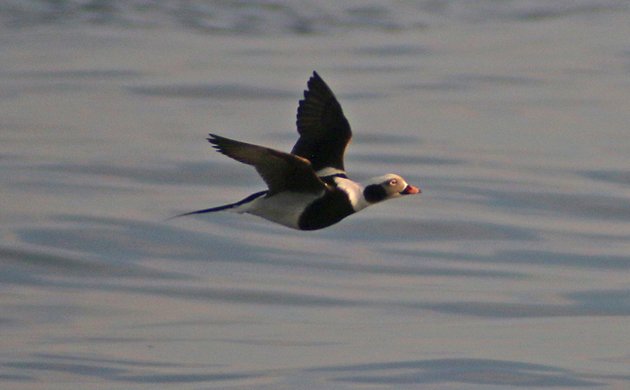
This past Saturday I made my way to Jamaica Bay Wildlife Refuge’s West Pond a bit before sunset in order to try to get more flight shots of ducks like these as they made their way in to the pond to roost for the night. On my way in I convinced a fellow Queens birder, [...]
Bufflehead are one of our most amusing ducks. The simple black-and-white plumage of the male Bucephela albeola might appear bland but not if you see one well and in the sun in which case the iridescence on its head shines. Bufflehead also have rather shockingly pink feet which they deploy like landing gear as they come to their [...]
A recent visit to Jamaica Bay Wildlife Refuge’s East Pond was rewarding in both number and variety of waterfowl, but none drew my attention like one particular Ruddy Duck. The little stiff-tails are almost year-round at Jamaica Bay though almost all leave to breed in the summer and in the depths of winter, when the [...]
The Redhead is one of the sexier of our ducks, if searches on Google for “sexy redhead” are any indication. It is a well-named duck, as the male does have a red head. Of course, other ducks have red heads too but for whatever reason Aythya americana got the name and now has to live [...]
The Muscovy Duck (Cairina moschata) attracts more attention than most ducks, at least in North America. When this native of Mesoamerica and South America is spied in the wild, usually in some corner of the Rio Grande Valley in Texas, it elicits admiring oohs and ahs. When a Muscovy is seen anywhere else, the result [...]
We here at 10,000 Birds believe that every bird is beautiful and, moreover, that every part of every bird is beautiful. Even we, however, tend not to stare too long or too hard at the nether regions of ducks dabbling for dinner. We understand that some of our readers really, really like duck butts though, [...]
Mallards can be dirty ducks. Very, very, dirty ducks. And while ducks in general are known for their hybridizing ways, none are as prolific and undiscriminating as Anas platyrhynchos. The list of species that Mallards are known to have hybridized with is long and in some cases Mallard genes threaten to flood the gene pool [...]
Years ago, Charlie Moores coined the colorful term “manky mallard” to describe the motley menagerie of feral and domestic mallards (If you’re wondering, manky means many things in British parlance from dirty and disgusting to inferior and worthless.) Here at 10,000 Birds, we’ve always celebrated odd ducks, which means manky mallards feel right at home! How varied are [...]
Everyone knows what a male Mallard looks like. The drake of this extremely common, sexually dimorphic species (Anas platyrhynchos) cuts a fine form with his iridescent emerald dome and chestnut breast. A female mallard possesses plumage as dull as her partner’s is bold, a frock of forgettable grays, browns, and blacks. Yet you would be wise [...]
Winter at Point Lookout, the easternmost point of land on the south shore of Long Island, New York, before one reaches Jones Inlet, can provide wildlife watchers with a plethora of pleasing options. One of my favorites species to see at Point Lookout since the first time I saw them there has been the gaudy [...]
According to my Peterson Field Guide to Birds of North America, the Common Goldeneye (Bucephala clangula) is “fairly common” but the Barrow’s Goldeneye (Bucephala islandica) is “scarce.” They also list the third member of the genus Bucephala, the Bufflehead (Bucephala albeola), as “common.” I find this categorization to be pretty accurate, so whenever I see [...]
As we roll towards Valentine’s Day, the U.S. as a whole is desperate for signs of spring. Montana is no excpetion. Just this week, Missoula was carpeted with more than 9 inches of snow in one 24-hour span, yet on the list-servs and in conversation the hot topics are the smallest hints of migration and [...]
I live in New York, and I was thinking about the lagoon in Central Park, down near Central Park South. I was wondering if it would be frozen over when I got home, and if it was, where did the ducks go. I was wondering where the ducks went when the lagoon got all icy [...]
Back in 2007 when I was doing my New York State big year I dipped on a Tufted Duck way up in the northeasternmost part of the state when Jory, Will, and I couldn’t find the bird on Lake Champlain. Perhaps the same Tufted Duck was on Lake Champlain again last winter but with a [...]
As I mentioned in my previous post, I had planned writing a post about ducks, and in the last week, I’ve been thinking about how I wanted to go about writing it. One could easily start by breaking them out along genus – like Anas, Aythya, etc, and discussing the difference between dabbling and diving [...]
The North Carolina birding community (and South Carolina too) has been hopping with the report of a White-cheeked Pintail, one of the more sharp-looking representatives of a particularly sharp-looking family of birds, at a wildlife refuge on the Outer Banks. But the bird’s striking visage is hardly the only reason the local birdery’s interest was [...]
When one is grocery shopping with the family on a Saturday afternoon and the phone rings, and it is a birder, odds are a rarity has been discovered. This happened to me yesterday and, well, the rarity was not only an impressive bird but it was in Queens, at Jamaica Bay Wildlife Refuge. As Daisy [...]
The Black Scoter Melanitta americana, called the American Scoter by some and Melanitta nigra by others*, is a large seaduck rather readily identified by the large, shockingly-bright-yellow knob on the male’s bill that stands out amazingly well against the all-black plumage that gives the bird its common name. The female is dressed in more muted [...]