Archive for ducks
You are browsing the archives of ducks.
Fitting in an outing to see some birds has gotten exponentially more difficult now that I am back at work. Spending time with Desmond and Daisy (don’t get me wrong, I love it!), putting the nose to the grindstone forty hours per week (which I love a bit less), and the fact that though the [...]
Yesterday, Sunday, three days before I was scheduled to be a dad (still not yet!) I was out and about in Nassau County with five other birders on the Queens County Bird Club‘s “South Shore Potpourri” trip, a yearly search for waterfowl both rare and common in the assorted small parks and ponds that are [...]
One of my favorite ducks is the Northern Shoveler (Anas clypeata). Something about their namesake, absurdly long, shovel-like bills, elegant plumage, and cool vocalizations make me want to see them on every birding excursion. Or maybe it is their clever methods of eating, whether straining the water with their bills or swimming in circles in [...]
Diabolical. Truly diabolical. That’s how I felt, anyway, when I made up the Diabolical Female Waterfowl Quiz. But, once again, some dedicated birders have proven themselves up to the challenge by managing to correctly identify all five partial pictures of female waterfowl, truly a magnificent accomplishment. To see for yourself the quiz pics, the images [...]
If previous incarnations of the Diabolical ID Quiz left you scratching your head this one might leave you wanting to cut it right off your shoulders. Female waterfowl, also called hens, are usually drab colors, the better to hide themselves when they are incubating their eggs. They are still beautiful, but in muted tones that [...]
The Diabolical Waterfowl ID Quiz was both more and less diabolical than I had intended. It’s surprising how drake ducks, with their bright colors, can still be so difficult to identify if one only has a small chunk of the bird to use for one’s identifying attempt. Nonetheless, correct answers were, eventually, given for each [...]
The Pochard is a diving duck of Eurasia, similar to the North American Redhead and Canvasback. Somehow, despite having visited several good locations like the Gulper See that should have had at least a few, no Pochard was kind enough to swim or fly through my field of view. Until today, that is, when, not [...]
So the Anaheim Ducks have won the 2007 Stanley Cup, their first in franchise history. I don’t know what’s funnier: that a team named after a duck took the championship, that a southern California hockey team beat a Canadian team, or that the 2007 champs, formerly owned by Disney, used to be called the Mighty [...]
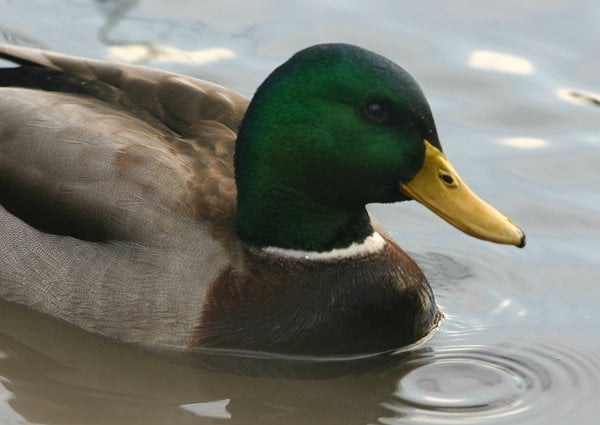
Mallards, though common, are often overlooked. Many birders consider them a “trash” bird, that is, one that is so common that they are hardly worth taking the time to study or appreciate. This is unfortunate, as the gaudy green of the male Mallard is certainly worth looking at and is matched in its brilliant beauty [...]
Back in 2003 when Sara and I first started birding, we encountered quite an odd duck in Central Park. This bird, pure white with a red, featherless mask around its eyes, was a Muscovy Duck. Originally native to South America, the Muscovy Duck is prized among farmers as a valuable meat duck. Wild Muscovies are [...]
November visits upon New York dank, leaden chill and multitudes of ducks. I vastly prefer the latter, particularly those species that don’t frequent this area during the warmer months. One beloved bird to keep an eye out for is the Bufflehead, a beauty in black and white. Bufflehead are fascinating little creatures. They are exceptional [...]
Alluring rumors of Pine Siskin enticed me to visit Van Cortlandt Park this weekend, but alas, just like every other time I’ve chased rarities there, I came up empty. New York City’s third largest park simply covers too much acreage, 1146 to be precise, with too few landmarks by which to chart sightings and too [...]
The taxonomic practice of speciation must be more art than science. After all, there are at least six distinct and recognizable populations of Dark-eyed Junco (Junco hyemalis) yet different species of scaup or Empidonax flycatcher are practically indistinguishable without resorting to DNA testing. Most higher animals are separated biologically, by the likelihood of gene flow [...]