Archive for shorebirds
You are browsing the archives of shorebirds.
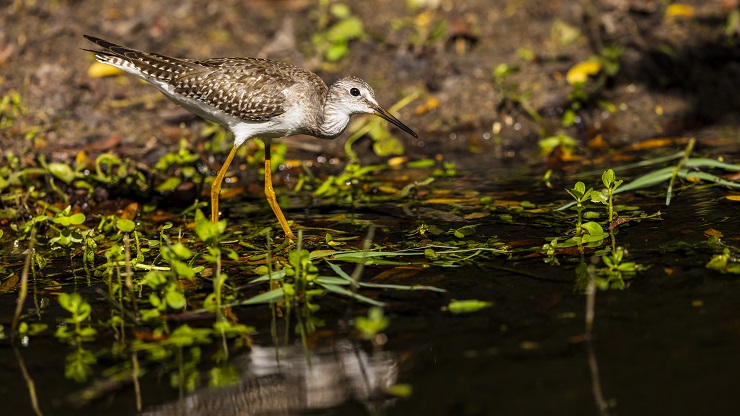
Greater Yellowlegs (Tringa melanoleuca) photos by Larry Jordan Shorebirds. Why are they seemingly so difficult to identify? One obvious reason is that most have plumage variations between their breeding plumage and non-breeding plumage. Plus many sandpipers plumages are very similar. Take the Greater Yellowlegs (Tringa melanoleuca) for example (click on photos for full sized images). You would [...]
We have spent most of our time recently with the shorebirds of Roebuck Bay. They have returned from the north, though more are returning and there is very little knowledge on their arrival back in the Bay. When they depart on their northward migration it is possible to go into Roebuck Bay in the late [...]
Long Valley is an intensively farmed area at the confluence of two rivers in the former British ‘New Territories’ of Hong Kong. It is divided into small plots, mostly less than 50m2 where the use of large machines is impractical and human labour is the main method of cultivation. It is highly irrigated and many [...]
I spent this past weekend at the coast, travelling to Arcata for a Northern California Audubon Council meeting hosted by the Redwood Region Audubon Society. This area includes Arcata Marsh and Wildlife Sanctuary, part of Audubon’s Humboldt Bay Important Bird Area (IBA). The Arcata Marsh is an innovative wastewater treatment facility consisting of 307 acres of freshwater [...]
We have a rare visitor in Broome at the moment, which is rather nice! The last time we had a Banded Lapwing Vanellus tricolor visit was 25th February 2008 and prior to that was 23rd September 2005. On those occasions the bird was on one of the school ovals, but this time it has decided [...]
Black-necked Stilt (Himantopus mexicanus) photos by Larry Jordan Click on photos for full sized images. This female Black-necked Stilt (Himantopus mexicanus) is distinguished from the male by her paler brownish back and scapulars. The male of the species has the upper portion of the head, back of neck, back and wings all glossy black. He [...]
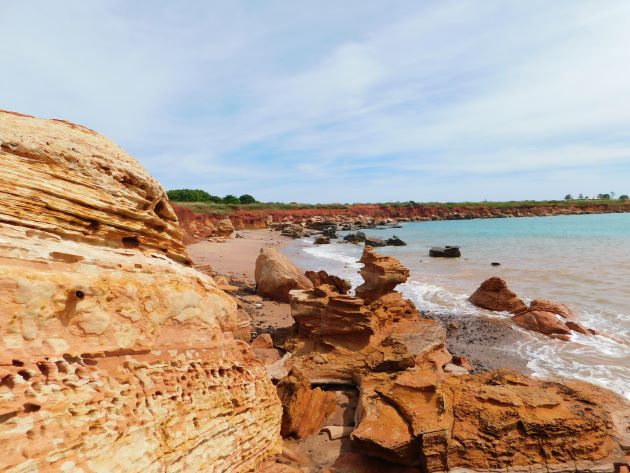
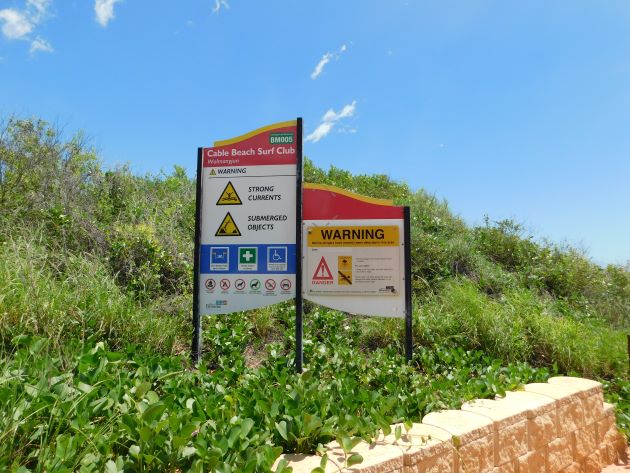
Everyone that visits Broome heads for Cable Beach at some stage of their visit. Many people choose to stay at a hotel within walking distance and enjoy the sun setting into the sea each evening. Camel rides are a popular sunset activity for those who want a slow walk! The most common bird along the [...]
We are into the second attempt at breeding for this season in Broome for Pied Oystercatchers. The first eggs are laid during the first week of July each year and if these eggs fail to hatch or the chicks are lost they will lay further eggs within a few weeks. We had one pair attempt [...]
Scientists at The Center for Conservation Biology have announced that Machi, a Whimbrel that they have tracked via a satellite transmitter for over two years and 44,000 kilometers (27,000 miles) was gunned down on the Caribbean island of Guadeloupe (French West Indies). This is a bird that flew over 3,400 miles in one flight from [...]
Irene sends her love. As might be expected she was feeling a little weaker after crossing the Atlantic and wasn’t quite the ‘big lady’ that she was on your side of the pond. Let’s just say she’d mellowed a little on the journey over. She brought gifts of course and for those we’re mostly grateful. [...]
Well one day this week saw me searching for shorebirds, as there must be some here somewhere that I can get to. There are signs up to explain that there are not many left due to reclamation, industry and pollution along the Nakdong Estuary, but I must be able to find something if I go out on [...]
This comes from BirdLife Cyprus’ research officer Mike Miltiadou, and shared by Melpo Apostolidou: Waterbirds that bred on the island this year. Kentish Plover / Credit: Jane Stylianou It’s just the thing that I thought birders from outside of Cyprus would want to hear that I had to share it in full: BirdLife Cyprus conducts [...]
Or Why Eating Raw Seafood Is Dangerous Or Ouch! That Looks Like It Smarts! Or The Hunter Becomes The Hunted What am I talking about? A very unfortunate Semipalmated Sandpiper that chose the wrong mussel to make into a meal. It was at Jones Beach State Park a couple of weeks ago and all of [...]
Any day that includes a sighting of a Red Knot is a good day for a birder. The bird we see in the northeastern United States, the rufa subspecies, is declining rapidly, “from a high count of 95,000 in the 80s and 90s to fewer than 10,000 earlier this year.” Fortunately for both the birds and [...]
This week has seen me do a lot more cycling and walking along the beach and more discoveries! Grant is currently overseas-more about that next week-so I have been making the most of my surroundings, as I will join him soon. I have covered the 23kms of beach that we monitor and discovered that nesting [...]
During the last week I have been monitoring the 23 kilometre stretch of beach that runs along the west coast of Broome. The tides have been suitable for me to cover most of the beach by bicycle and this enables me to cover most of the area in a day. This is the time of [...]
It’s a plover, and it lives on the shore. What more do you need to know? Actually, there is a great deal more that could be said about the small Shore Plover. One of only two species in the plover genus Thinornis, the other being Australia’s Hooded Plover, this species is another New Zealand endemic. [...]
We monitor the Pied Oystercatchers breeding along a 23km stretch of beach each year and it can all be covered on foot or by bicycle-tide dependant! They usually have their first eggs in place by the first week in July each year and they sit on them for 28 days. The first egg is laid [...]
Willets are a very bland shorebird until they open their wings and take flight. Then the flashing black-and-white is extremely eye-catching and makes you wonder how you overlooked them when you scanned the marsh. And if you somehow miss them in flight they will definitely make you aware of their presence with the loud, repetitive [...]
Hey guys, how would you like to be chased by up to ten females, all seeking to mate with you? If this sounds good to you, you may wish you were a Wilson’s Phalarope (Phalaropus tricolor) or any of the three species of Phalarope. As strange as it may seem, sexual dimorphism and breeding behavior [...]