

Wallace Stevens’ “Thirteen Ways of Looking at a Blackbird” is a marvel of modernist poetry. It is only 246 words long, divided into thirteen sections, each labeled with the corresponding Roman numeral, and a surface reading will show that it is about, not surprisingly, thirteen ways of looking at a blackbird. Reading deeper, though, will allow the reader to understand that much more is going on in those scant 246 words.
Wallace Stevens needed to find new ways of looking at common things seeing as he spent his working life behind a desk at an insurance company. This made him
concerned with the transformative power of the imagination. Composing poems on his way to and from the office and in the evenings, Stevens continued to spend his days behind a desk at the office, and led a quiet, uneventful life. (source here)
Of course, the poem is not actually about blackbirds, or looking at them, but
a work that well demonstrates the power of poetic language; transcending definite interpretation, like myth, it provides a match and a mirror for the engaged reader. A match, as the verse ignites thought and interpretation, and a mirror, as this process of interpretation (in conjunction with the nature of the verse) allows us to reflect back upon our subjective assignation of value and meaning, offering the opportunity to gain insight through the process. (source here)
One stanza of the poem, the eighth, serves nicely to illustrate the above analysis.
VIII
I know noble accents
And lucid, inescapable rhythms;
But I know, too,
That the blackbird is involved
In what I know.
One possible explanation of the stanza is that the “noble accents” are that of Stevens’ boss and the “lucid, inescapable rhythms” are those of his office. In that interpretation, Stevens’ knowledge of the hierarchy at work is informed by the literal pecking order of blackbirds setting up territory, marking their turf with their noble “conk-a-ree” song. But, definite interpretation is impossible, as Stevens could just as easily be referring to the changing of the seasons with “lucid, inescapable rhythms” and then the blackbird’s migrations and life cycle would be how the “blackbird is involved / In what I know.” Either of these interpretations is entirely subjective, and anyone who reads the poem will come up with a completely different interpretation. Mine, for example, were strongly influenced by the knowledge that Stevens worked an office job and by my familiarity with Red-winged Blackbirds. Another reader, with different knowledge and experience would probably not come away from this stanza with the meaning that I did.
Either way, it is food for thought, and a reminder that there are at least thirteen ways of looking at a blackbird.
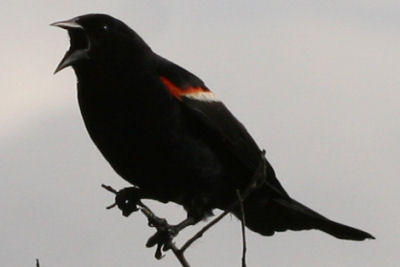
And here is a blackbird sharing his “lucid, inescapable rhythms” with the world.
…
This post was originally published on 30 November 2007. It was republished as a way to introduce it to readers who have found 10,000 Birds since then.
…
If you liked this post and would like to browse the entire archive of poetry posts on 10,000 Birds please check out our Bird Poems page.
…















The great joy of poetry is that there is no one true interpretation. I used to sit in literature classes and fume as the professor talked of interpretations that differed from the poet’s own vision. Now, I simply accept that all those views are valid and meaningful. Poetry is meant to stir you on many levels. This poem definitely does that. Thanks!
And I always vaguely think of the blackbirds in the poem as being the European variety, even though I know perfectly well that Stevens was American.
Stevens, I’ve always thought, captures much of the way of the world in a very taoist fashion. And when ever I see poems interpreted I think of this stanza from the Tao Te Ching by Lao Tzu…
“The tao that can be told
is not the eternal Tao.
The name that can be named
is not the eternal Name.”
To me the poem is a cute illustration of how, endowed with imagination, we can look at the enigma of life – call it a blackbird – in a myriad interesting ways.
OK, does anyone get this poem, Im in 7th grade and my teacher gave it to me for annotaions and I don’t understand a thing
Dear Sean
I think your teacher is cruel. I am a retired English literature teacher and I would never give it to a 7th grade student. I have read it many times and don’t understand it myself. A lot of what is written about it, is pretentious. Poetry should not be a puzzle…
sean
i have also been asigned this poem for recitation and interpretation, i feel your pain, don’t feel too bad. i don’t get it either.
I first read this poem as a second year english student 42 years ago.It still haunts me.
I hate this poem. It needs to go die.
Stupid First Year English.
Love Stevens, love the poem, love that inspired a (non-bird-related) poem of my own, love you for reposting this, Corey! And most of all, I love RWBB.