

Here in North America, we contend unendingly with invasive birds like the European Starling, Mute Swan, and House Sparrow. In Australia, they are grappling with the threat of the Common Myna. The Common Myna (Acridotheres tristis), also called Indian Myna and House Myna, ranges naturally from Afghanistan to Indochina, but has been introduced into tropical and subtropical oceanic habitats around the world. As anyone with knowledge of how alien species can destabilize even robust ecosystems might surmise, the Myna is causing major problems.
Give credit where credit is due. The Common Myna is a good looking bird. Chocolate brown with a black head, the myna makes a bold statement with its brilliant yellow beak, eye patch, and legs. It also walks rather than hops, just like its rapacious relative the Common Starling Sturnus vulgaris.
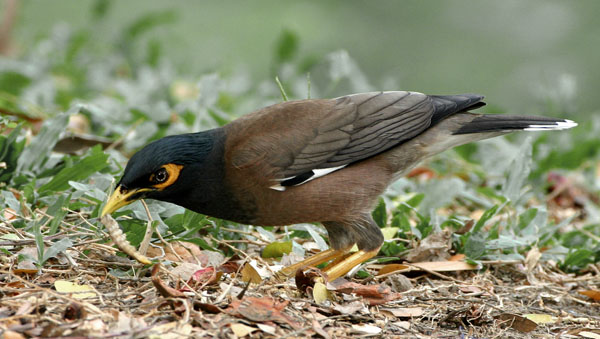
Common Myna, Bangkok, Thailand
Beautiful and belligerent, the Common Myna is one of the world’s most successful bird species. They are super-competitors, one of only three birds on the list of One Hundred of the World’s Worst Invasive Alien Species. The Common Indian Myna website is quite voluble on the length and breadth of this bird’s depredations: they damage fruit and grain crops, their noise and smell can be annoying where they are in large numbers, they spread mites and disease to people and domestic animals, and they sometimes snatch food off people’s plates in outdoor eating areas. There are even a few rare records of mynas attacking people.
The myna’s worst offense is its own success, as it thrives at the expense of native species. In Australia, Common Mynas reduce biodiversity by fighting for hollows with native birds, destroying their eggs and chicks and stopping them from breeding. They also evict small mammals, like Sugar Gliders from hollows, which are in short supply over much of Australia because of clearing for agriculture. When a single myna is too weak to dislodge a competitor, a group of them will form a mob. Behavior like that doesn’t exactly endear a foreign species to its hosts; the myna beat out stiff competition like the Cane Toad and Cockroach for the coveted 2007 Pest of Australia Award.
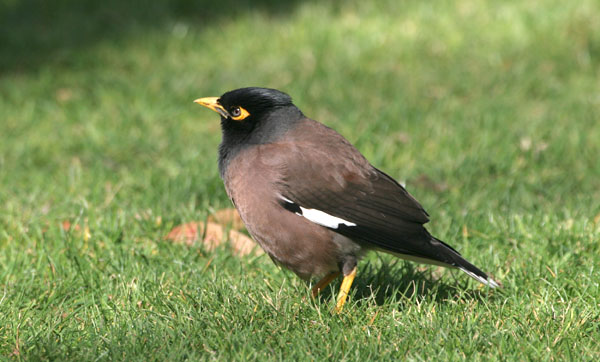
Common Myna, Sydney, Australia
The scope of the myna invasion is daunting to say the least. Even if there was a way to diminish, say, the North American population of House Sparrows, who could afford such a vast initiative? If anger is impetus enough, the Australian people will win this war. However, a long history of adaptable invasive avifauna assures us that it takes more than just elaborate cages, multi-sound traps, and wrath to deter robust ruffians like these. In the meantime, perhaps they can take solace in the fact that the Common Myna is being outcompeted in its own turf by its own cousin, the Javan Myna. This invader, first detected in Singapore in the 1920s is now the most common bird in the country. Turnabout is fair play, right?
Photos copyright Charlie Moores 2007







The Common Myna is apparently doing rather well in the Miami area, could be we have to deal with it ourselves soon…
It’s one of the most noticeable birds in urban parts of South Africa too – you can’t go to Johanesburg/Pretoria without tripping over them. Introduced birds – not a good idea eh?
I can imagine how Aussies must be feeling. I can’t even put out bulk seed in the feeder anymore because so many house sparrows take it over, making a mess, and generally swarming the feeder to the point of pushing away finches, chickadees, and other small birds that might like some seed.
The European Starlings are just everywhere, too. Huge flocks. Although they don’t pose a problem at the feeder, they must be causing problems, as all of those birds need to eat and nest.
Hopefully someone contains the Myna in Miami before it spreads throughout the US. Invasive species are nice, if they would stay balanced, like the local species. But, inevitably, they turn out to be better adapted and more aggressive and end up becoming so numerous that the locals can’t win. Too bad.
lovin this website for some reason <(:)
Im from Australia and believe when I say that they are so much more annoying then what this website claims. for exapmle one day when i was eating some fish and chips one of those little buggers came and swiped a bit of fish from from right infront of me. i was like omfg wtf?!? Then it came back but there was two of them this time so i had to get up and move to a different place because they kept trying to snatch my food 🙁 They must be stopped!
I am reporting from Brisbane, Australia. This morning May ’08 I was returning from a car trip and saw a Common Mynah pecking at an intact Common Mynah laying in the road. The pecking bird flew onto an above branch as I stopped to see if the injured bird needed my aid but it appeared lifeless and dead. Approx 2hs later when taking the dog for a walk the bird in the road had been dragged to the kerb and had it’s tail feathers pecked away revealing a bloodied patch of bare skin and also the feathers on the back of the head were pecked off. I don’t believe it was interfered with by a cat after I initally saw it due to the aggressive behaviour of the attacking Mynor. Has anyone else witnessed a one on one attack like this?
They are all over Hawaii, too — one of the most common birds there, from downtown Honolulu, to the farmlands of central Oahu, out into the forests of Waianae. In Hawaii, unless you go WAY up into the mountrains, every bird you see will be an introduced species.
We need to train birds of prey to hunt down these invaders. This a natural method without reverting to other methods (chemical etc), which have an impact on bird and animal species. It is annoying to wake up in the morning and hearing this bird competing in song with other birds found in the bushveldt in South Africa.
mynas are important in our ecosystem we need to save them
only the noisy myna is important to our ecosystem.
on the other hand they common myna IS NOT!!!
all they do is bother everyone
I witness every day how they torment and invade other bird species territories and nests. My opinion is also shared with many people in South Africa. Why do poeple hate myna do not understand the impact of this bird in a habitat other than their original environment. Kill them!!!!
I live on the mid north coast of NSW Australia. I am employed by Landcare NSW to help control the spread of the Indian/Common Myna in our area. I am coordinating a trapping and controlled shooting program which is proving quite successful.
Not only do these birds deplete biodiversity they are also a human health risk, especially if they are breeding or roosting near your home. Bird lice infestations are not pleasant and can take a long time to clear!
I feel uncomfortable about killing any animal due to human error (introducing them) … however i have to remind myself and you that by taking one life you are in effect saving many more lives!
find out more at http://www.indianmyna.org
The only real PEST on this planet is the human being himself.
Talk about ‘threat to Nature’!
Leave animals alone!
Stop killing them for your own stupid greed!
Common myna is a beautiful bird with a wonderful song.
And it’s gotta feed itself to survive just like you guys.
hi Sibel and all
i commented earlier on the 11th November.
i understand your concern, but in my opinion facilitating an Indian Myna / Common Myna control program, we are minimising the effects of past human error. i know this is not fair and there is no doubt this planet would be happier without humans. i see my job as trying to help regain some balance from the introduction of modern humans to planet earth, or perhaps the introduction of greed or further more the mind set of a non dual reality.
they are beautiful and wonderful but just as beautiful and wonderful are all the native species they are killing. and they kill not just to eat, they kill their own kind and kill for breeding territory (sounds familiar). their biological behaviour program makes them scratch out chicks and unhatched eggs of Parrots, Lorikeets or Kookaburras (plus many many more species) just because the decided to nest near by!
perhaps im kinda like the UN for the fauna world…. perhaps… sometimes we have to intervene. it is real.
thank you
There are special traps you can buy which trap common mynas and starlings. I have heard that somewhere, quite a few people in a neighbourhood bought these traps and actually eliminated all the common mynas in their area!
I was brought up with the belief that they are vermine…
i used to be a kinder garden teacher and one cold winter day i noticed a masked weaver that really look rattled by the winter he was sooo thin so each time i gave the children sandwhiches i gave him some too and eventually he was looking beautiful! The nicest looking bird around for the time of year – his feathers were bright again and he was looking healthy…by mid springi had a small flock of various birds coming for snack time i would whistle and they would come out of the tree tops… The Mynahs used to wait until the other birds had finished before they came down i began watching the mynah family that lived near by and to my amazement they are really very caring birds. The parents still ate with previous years hatchlings (who by now are almost adult) when that seasong chicks were old enough the entire family ate together… and cared for one another. The older chicks “babysat” the younger ones and so on…
They never chased the weavers and sparrows away they mere ate on the otherside of the wall, IT WAS THE PIDGEONS that ruined it for them all the pigeons started to crowd me and the mess they made was terrible that to spite the fact i enjoyed my little friends coming for lunch i had to stop feeding them. Is there a kill pigeon website??? now they are pests – look at London New York Johannesburg Pretoria anywhere there are lots of people there are lots of pigeons!
I just moved into a house in Melbourne Australia.Ive notice quite a large number of myna birds in the area.These little pests are not only noisy,they swoop and attack people that walk past my house.Ive recently seen one of the little buggers harras a crow in flight.Never before have i had so much hate for these pests.
I live in Pacific Harbour in Fiji. Sitting at the end of my swimming pool I have a large stone buddha. Through out the day in singles or in pairs our native Kingfisher birds rests on the head of the buddha and dive into the swimming pool, quickly returning to buddha’s head to preen themselves…a beautiful sight…they each spend a little of time then fly off to do their thing! Occasionally, I also have our local parrots that roost high in the trees to nibble on the seeds of our palms trees and on the Qaraniqio River banks amongst the mangrove there is always a white and grey heron, a pair, who make their way through the mangrove at low tide, looking for crab or small fish…then you have the Indian mynah birds…
I am so over these “flying rats”, that I am now on a rampage to remove them once and for all…they are nesting right now, so we’ve removed nests from every crevice in the roof of our villa and nailed several layers of chicken wire in place. Being very territorial they are now fighting for new territory. They are definitely aggressive, ruthless, cheeky, noisy and multiply rapidly. The fact that they eat the eggs of our native birds and the fact that they take over the nesting areas of our natives, just leaves me so furious. I have wondered why we have allowed these birds to multiply as rapidly as they have to the point that it could be a hopeless exercise to rid us of these pests!!
Basically I want to make our area a safe haven for our native birds…can anyone give me ideas on how I can do this…I am desperate to do what I can to save what endemic species we have already and do away with the Indian Mynah’s for good…
I love cats, but choose not to have one for the simple reason that I don’t want the natives spooked…
Any ideas will be well received…vinaka
From Singapore. Believe it or not. The introduced Javan Mynah has outcompeted the Common Mynah to become the dominant species of flying rats here. Look out!!!
I live on the East coast of Australia, we have a lot of mynah’s around our area. I have been aware they are a pest for some time.
However yesterday my wife received a canarie for a present, she put the cage just inside near the backdoor, with only the screendoor closed
Unbelievably, the mynahs were constantly hanging onto the outside of the screen just looking at the canarie. I don’t know what their intentions were but I would not have liked to open the door or let the canarie out. I doubt he would have lived for long, they seemed vicious to me.
How can I kill them?
i wish some body could ship some of this birds to me in canada i would pay for shipping
I think Antonio should reconsider his comment. what is your intent? do you understand the consequences of this or are only trying to get a reaction on your comment!
I relocated to Zambia (africa) with no myna in sight. what a pleasure. they should stay in their natural habitat!
I am proud to say I have culled almost 5000 common Mynas in South Africa over the last 4 years. Together with a few friends we have almost culled 15 000 in the last year alone and STILL they increase in numbers and endanger our indigenous bird life everyday. The biggest problem we have NOW is that our country has now added them to the indigenous population because they do not know how to control the problem. We have always tried to get permits to hunt these birds, but now it will be near impossible. Talk about your all time dumb ideas. Typical South African government mentality. I’ll keep on hunting them illegally of course, but it would’ve been nice to do so without fear of prosecution.
I fully agree and support Mynakiller. I would even sponsor ammunition to eradicate this pest! Keep up with your good work and don’t let the SA government intimidate you.
Dear All:
I have been working with mynas in islands as invasive species, by controlling and eradicating them (Trapping, shooting and poisoning). The Common myna (and maybe the Javan myna) is one of the most dangerous invasive species, specially on islands.
I trapped 623 common mynas in 53 days in my last control campaign in Ascension Island (2009).
And I’m vey interested on keep on working with them. Any suggestion? I love travelling, I trap mynas in a very effective way and I have been able to eradicte them from 3 Macaronesian Islands!
Mynakiller, do you need a hand in South Africa?
Please, any queries at: odisea64@hotmail.com
Kind regards, Susana
We can make a holiday of it Susana. 😉 You bring the traps and your weapon of choice and I will provide lodging and LOADS of Mynas.
5 of the critters had the misfortune of landing on my lawn this morning, just as I was about to get on my bike to go to work. I love it when I don’t have to go after them and instead they come to me. What a great way to start the day. 5 Mynas = 5 silenced head shots.
@Susana & Mynakiller: It is one thing to remove an ecological invader but it is another thing entirely to take joy in killing. It takes a sick mindset to find killing five birds “a great way to start the day.”
Ja…I’m not going to lose any sleep over that comment Corey. I admit I am a little twisted when it comes to killing Mynas. It makes me happy. Are you suggesting I feel sorry for killing these pests? Should I ask for penance and forgiveness for every Myna I have killed or rejoice for every indigenous bird I’ve saved? I tend to lean to the latter. You should try shooting a few….you might like it….heaven forbid.
With you, Mynahkiller, BUT … we should be certain that we are talking about the same thing.
I’m in inland Australia (well, a bit West of the main eastern range) and we have an invasion of the Indian (or Common) Mynah. They are displacing native birds. The Native bird is the Noisy Mynah, and it is a beautiful, nectar eating bird which has suffered at the hands of the imported Common Mynah.
Methinks Corey needs to live with an imported PITA like the Common Mynah (or the Cane Toad) to understand the angst (and the enjoyment of despatching these vermin to their just end) involved in having them take over our beautiful country.
Whilst the Common Mynah is a beautiful bird, it should NEVER have been brought into Australia. Now that it is here, and has escaped captivity and breeds (almost like rabbits – don’t get me started) and outbreeds/outcompetes native avifauna, we have a duty to despatch as many of them as possible.
Go Get’em, Mynahkiller!
We’re on the same page. 😉 We do not have any other Myna species here in South Africa but for the Common (indian) Myna.
They’re the only ones my list.
Indian Myna’s are amazing creatures. fit for survival. i stay in (SA) they are everywhere and i love them. in my experience they only attack people when they have a nest or are threatened for some reason or other, like most animals do to protect themselves from us humans. i had an Indian Myna as a pet a while back as i took him/her in because he/she was injured. and last night i actually found a baby Myna in danger so i took it to our wildlife rescue centre. here i am trying to save these amazing creatures and you are trying to kill them off. humans started this “invasion” now you must live with the consequinces. killing innocent birds due to human error. how selfish.
All the best to the exterminators of this terrible pest.
@ TaM. Please do some proper research on Mynas before defending these evil creatures. They are pests. Farmers brought them into South Africa to control insects etc eating their crops. This back fired severely because the Mynas then ate the crops and insects. They are intrusive and a pose a huge risk to the indigenous bird population in South Africa. Once they take over an area they chase away ANY and EVERY local bird in the area. Please don’t be so close minded as to think they are cute and that we shouldn’t do anything about controlling these pests. Would you like it if your house had a rat infestation? Same thing, different specie. Where in SA do you live, I’ll come around and take care of the problem for you. Soon you’ll have a variety of colorful indigenous birds in your garden and no more squawking, flying, disease carrying pests. You do realize they carry a multitude of diseases like Encephalitis and Chlamydiae that can be carried over to humans?
I was not concerned about the Mynahs coming into our area because our winters are very harsh.It gets up to minus 14 degrees celcius. Last winter I saw these birds but were not sure if they were Mynas. It was two birds.
If only I knew, there were two, now ten, I have alerted all my neighbours to kill each and every one of them. We have 56 species of birds in our vacinity.
I hope my neighbours see the urgency of the situation.
John
Bloemfontein
South Africa
I’m in Pretoria, South Africa. We also started with a few birds and they just multiplied. After some research, I found out that they have about 2 chicks every three months. They are like rats! I’m doing what I can to keep them out of my garden, successfully 😉
Hi Fernando
Please tell me how you control them, I was thinking of waiting till winter te start shooting them when they are roosting. Apparently they are very clever. I want to use the cover of darkness to kill them systematically. The reason I want to wait till winter is because the lack of leaves will make it easier to see them.
John, they roost in summer and winter. But it is true what you say, in winter you have less leaves to contend with. Tip: Go check out shopping center parking lots with big trees. I’ve found a roost in JHB shopping center in a huge tree standing in the parking lot. Well lit with orange flood lights. perfect for night sniping. Pull in, park and go at it from the car window. Just check your back stops (brick wall etc, you don’t want to injure someone) when shooting up in the air and make sure you have a silencer fitted. WARNING: You do not want to be caught shooting in a built up area. R10 000 fine and immediate arrest.
As for my weapon of choice. Air Arms S510 PCP Air rifle fitted with classic cylinder for extra shot count, silencer and a 10-40×50 scope. More effective and human than trapping and gassing. Go for chest shots, not head shots. Chest shots take them down immediately. Head shots make a mess and you stand a greater chance of injuring them than killing them.
Also, hunting at night is the best option when it comes to roosts because Mynas are near blind at night and won’t fly off out the roost’s safety. With the silenced rifle they have no clue as their comrade curry chickens start falling out the tree. Optimal rig will be one with night vision fitted.
Be safe, be responsible.
@ Fernando, PTA has a HUGE Myna problem. Check out Midrand, close to Vodacom. Voortekkerhoogte. Centurion area. PTA west golf course has close to 2000 Mynas on the golf course ALONE. I want to get in contact with the grounds admin and request permission to come sort them out on a quiet day. Check out parks, suburbs and anywhere where there is freshly cut grass. Best times are in the mornings at sunrise, +3 hours after. Lunch time they sit in trees but sometimes tend to forage in and around large grass areas like parks, sport grounds etc. that are blocked off, and then late afternoon, 2 hours before sunset. Let me know if you need more advice/tips on how and where to eradicate these pests.
Hi
Thank you very much for your detailled information. I have noticed that they feed in groups on the ground, luckily for me I have a two hectare plot with 400 trees and scrubs to defend, it is outside of town so I thought of shooting them with a shotgun on the ground and with a .22 with “dons hael” I don’nt know the English word, whilst roosting you never miss because it spreads. The problem is the sound and I would like to pluck them one by one.
If only we could stand together like this to solve all problems.
Greetings
John
Please! Could you post the coments in english, I get very frustrated when I can not understand them. Sorry for any inconvenince ;-).
Thank you very much in deed!!
Kind regards from the myna free Canary Islands, Susana
It sounds kind of like the problems we have in North America with House Sparrows and Starlings except even worse. I see it as our responsibility to kill invasive species since we were the ones who brought them in. If we don’t we will be responsible for the native species going extinct. Fortunately we haven’t lost any species in North America yet due to invasives, but the Eastern Bluebird might have if not for the House Sparrow excluding nest boxes.
does anyone in Johannesburg know who i can contact to get rid of the mynas in my garden. they are so territorial that even if i walk into my garden they swoop down at me and go on attack mode. they have almost clipped a kid in my neighbourhood and I have no idea who to contact. help please
Hi Lee,
You can set up a trap in your garden, and remove some of the ones you’ve now. Better will be if you and some of your neigbours set up some more traps, all together. A Myna management plan as the one needed for your country needs a lot of work, but I’m convinced that a difference can be made by single people. The tandem one person one trap, I’m sure, it will make a difference, as it has done in Australia. Please, have a look to the Canberra Indian Myna Action Group web page. Is very interesting, full of practical information and they have plans to build the traps by hand. Get involved and help your native ecosystems to survive the war against invasive species like mynas. Is not a matter of hate but of responsability and care.
Cheers
@Lee
There are numerous pest control businesses in the JHb area you can contact to assist with the problem. Google or yellow pages. 😉 Lots of them specialize in trapping invader bird species. I would offer my services, but I prefer to stay anonymous as it is still illegal to shoot ANY bird with an air rifle in South Africe as well as in a built up area. Rather safe than sorry Lee.
@ Lee, if Mynas attack as you say they do it usually means they have a nest with chics in the area. If you can get to the chics and trap them, mom and dad will follow with out a doubt.
Hi All
What type of bait do you offer the mynah. The one solution is to start breeding Minah and try and make money from it. Anything that has a price tend not to breed that well(Ha Ha)
Hi John
a Myna will eat anything but they seem to like maize(mieliepap)and bread a lot. You can also try mince. Best way of course is to get a sound clip of a Myna in distress and play that in your garden. Works like a charm. 😉
Hi Mynakiller
You are very clever to think of the soundclip. Can anyone please see if they can get hold of such a clip for us to download. I also have an idea off the wire on the ground and “haasrek” between the two pins. We made it as kids. It is unfortunately indiscrimanate but if you can lure only minahs with the distress call you could kill 20 at one time. I do not want to go into details of how it works but since you are a Afrikaans south african you might know what I am talking off.
John, I’d rather you don’t use the haasrek. Sure it works well, but as you say it is indiscriminate, and the whole point here is to safely get rid off the invader, not everything around hind. I sent you a msg to your conference center’s email address. Keep an eye out. I have such a sound clip which I will happily send to you.
For those living in Melbourne and surrounds who are troubled by these pests, there is an action group that mentions traps available for $55 – made by volunteers at a Victorian men’s shed. Way cheaper than what I just paid ($169incl postage) and way, way cheaper than the $250+ traps sold by a commercial pest disposal group. (I am being swoopeed as soon as I step into my carport from the front door -not nice!)
Just wanted to make a point. The fact that common mynas are a introduced pest is true. However there has been absolutely no proof that mynas kill other chicks/eggs, take over nesting hollows or are even aggressive. If you are killing them do not think you are helping any native wildlife. Yes they nest in urban areas and poo on our cars, houses etc. However that is a human issue. We encourage their nesting by being careless with our wastes and leaving food (eg. pet food and fast food) out for them and create lovely buildings which are a perfect habitat.
Scientific studies are showing that other species in Australia such as the Noisy miner, Rainbow Lorikeets and Sulfur crested cockatoos (all natives!) are the major contributors of taking over nesting hollows and being aggressive towards other birds. THIS IS A MYTH. I know this having been a part of many recent scientific projects which proven that indian miners are of no/little threat to native species and having mentors which have been working on this too.
Bio Student.
Come to South Africa and see for yourself. WITS University is also busy with a study and it’s a proven fact they attack and chase away other birds within their area.
Besides that, It’s plain obvious. I’m no biology student and I’ve witnessed that in every area where I cull Mynas, other populous of bird species have returned and nested, where it was previously overrun by Mynas and Pigeons alone.
AND
I’ve seen many a Myna attack other birds with my OWN EYES. Hell, they’ve even attacked my mother in law!!! You should maybe redo your “scientific studies” and rethink your conclussions mate.
Besides the obvious threat towards other bird life you should maybe also look into the danger they possibly have towards man, i.e. the diseases they carry… If you know ANYTHING about a Myna, it’s how filthy the buggers are. Just look at their nests. I don’t dare touch them after I’ve killed them. I use a tong or a plastic bag to handle them.
Go do some more studying before you try and convince me that a Myna is NOT a danger to any area.
Are you sure you were studying the right birdie????
just asking…
Is it stil illegal to shoot mynas in SA?
Mynakiller we must meet…..
It is illegal to shoot ANY bird with an air rifle in South Africa…but we do what me must. 😉
MynaSniper…where in SA are you?
Pretoria east
drop me a mail private1921@gmail.com and we can chat. I’m close to you.
I’ve got some sites you can join where we discuss the culling of these pests in detail.
Great. I sent you a mail.
here in southern china.there’s no fear in the spread of the myna birds.and i have kept one as a pet for several years.i ‘ve tried to teach it say “hello”in chinese.yet i always think the common mynas are
our best friends and share my happiness in chinese website http://www.baidu.com, until i found you all talking about killing them as “evil pests”!i was shocked!i wonder why mynas are so harmful in
Australia,Arica…as an introduced species.and in Wen Zhou ,China,it is even hard to catch sight of one!the place where i live is seriously polluted.so is it the bad environment that controls the amount of the birds?
Hi
I have been watching the Myna’s very carefully since I spotted them last year and was waiting for winter to start culling them. They were two last winter are twenty now.
I however up to now have not seen any agressive behavior from them or chasing away other birds. Apart from breeding like rats they do not bother me. I hated them from what I have read. They really do like bread but the other birds chase them from the food. Am I speaking too soon??
Regards
Hi people,
“Beautiful noisy miner”? I just got back from a rather stressful noisy swooping session (I got swooped about 7-8 times). At one point I was looking straight at the mongrel when it came in for the swoop. (I punched the air in front of it to scare it away.) I know the Indian miners are environmental pests, but I’ve only ever been swooped by the noisy miners…and I don’t consider them particularly beautiful!!
I consider them a pest and I am determined now to kill them off with an airgun. They drive all the very rare and beautiful birds in our garden away.
This myna is the worst bird I have come across. A group of 3 myna’s kept stealing my dogs food until Fatty(my dog) killed one of them . The remaining two seem like they want sweet revenge on Fatty. They are really after fatty by making s creacking noise and trying to beak Fatty. This really got me thinking , are they taking revenge on Fatty for the death of the dead bird or are they just scared they will be next to go to heaven ?
My daughter caught a small little myna 2 days ago and fell so in love with it and I have let her keep it. She even took it to school. I had no idea that they where carrying sicknesses. I knew that people considered them pets but never really done much research. My dad also used to have one some time ago but we gave it away when my daughter was born because it was quite aggresive. It was also very messy. I hated that bird but when my daughter came with this one home I thought it would be good for her as it is the only pet she had. The bird died this morning and she is heartbroken. I actually wanted to read more on how to take care of them should she ever find one in the future until I came to this website. I always knew people hated them but I havent really tried to find out as I never really worried to much about it. John, maybe you should start selling them to china, seeing they dont have much of them there LOL.
I live in Durban, South Africa. Today I was attacked by one mynah while walking to the car, it sunk its beak on top my head and made me bleed. Last week they attacked me in my flat, getting in through open window. This is like Hitchcock horror movie… I’m getting pellet rifle, this is a war.
I,ve been watching them around my house and they’re nasty bastards, forever intimidating the local birds and intruding on their nests and space! Our local birds doesn’t have a chance. I’m getting an airgun and doing my part!
Wow! Ill come help you guys!!!!
I will help you too!!!
Having seen the behaviour of mynas in Australia, I have a deep hatred for the pests. They harass native birds, pick fights against bigger birds, mob other birds for food, shriek with all disharmony and look and act like the ugliest, little bullies. Plus they peck at their dead.
And now they’re even worse because it’s BREEDING season down here. They’ve taken up nests in the gaps of my roof and are making the worst noise from day to night. Enough is enough and all sympathy for them has vanished. Now how should I begin my war against them?
A very good idea is to get organized by groups of volunteers in the neighourhood, as the Asutralians have done,and start asap to build traps and trap. Well organiced, the impact could be very valuable. If mynas do breed twice a year there, you should start trapping just before the breeden season, in order to disrupt as many couples as possible. By the other hand, a volunteer group could put pressure over your politicians, to try to make them react and set up a national myna control (better of all will be an eradication) campaign; but from my exerience, political people do not care, even further, they are the ones who let mynas to get legaly imported into the country.
Fighting with mynas and with politicians is a very hard task, but it can be done, and success can be achieved!
Wish to be there to give two hands…
More info, Canberra Myna Action Group. They are doing a great job.
Best regards from the free myna islands!!
Susana
Hi guys.
Please, please be very careful when shooting these pest with air rifles. Shooting a air rifle in a built up area and shooting ANY bird with an air rifles is ILLEGAL in South Africa and can land you in jail!!! OR cost you R10 000 in fines and JAIL time. I suggest getting an air rifle with a sound supressor so people are not aware of your actions. ALSO, ALWAYS, and this is super important! NEVER, ever shoot into (up) a tree or the air. ALWAYS make sure that there is something solid behind your target, like a wall or a tree trunk, or if you are more elevated than them, grass. NOT when they are walking on a road or concrete as the bullet can ricoche. Also practice and get to know your gun before you partake in shooting them. Injuring an animal is cruel, regardless of how much a pest they are. I use to do this to attract other Mynas, but I have seen and heard some real gut twisting stuff and have stopped doing so. Be sure you get a CLEAN kill. Go for the chest or back. Never the wing and if you are good enough, go for head shots. BE SURE. Also, shoot the bigger of the two first, this is usually the female. The male will fly off but will always return for it’s partner. Take him down next. Also shooting the female first will ensure their roost to fail. The male does not provide for the youngsters or looks after eggs. If you get the female, you have succesfully stopped a roosting pair. To give you an update of the epedemic in SA… with all our efforts and shooting thousands of birds each year their numbers have still increased ten fold. Contact the WITS universaty for a more detailed update on the increase in numbers in areas around South Africa. As far as I know, they are still busy with the study on these pests.
Be safe, be quick, be deadly.
Greetings,
MynaKiller.
Another thing…
Try and clean up your kills. Use tongs to pick them up and put them in freezer bags in the freezer. Do a search for local Game Bird sanctuaries in your area. a Lot of them will take these frozen treats off your hands and use them to feed the game birds.
Another reason for cleaning you kills is that Mynas will then return to your are so you can kill more of them. Leaving a dead myna on the lawn will deture any other mynas for months!!! BUT, by doing so you’re just making them some other guys problem. It’s not like they’re going away anytime soon and out of sight out of mind thing doesn’t work for my peace of mind…. I still hear them, be it a few houses down. If you have such a huge psychlogical problem with them like me, trust me it doesn’t help. 😉 I will not rest until they are ALL gone!
@MynaKiller
Great work man! I share your passion for killing these pests. I live on a small holding just outside of town and I do the same where I live…sad part is the mynas dont visit anymore…although I do see hundreds of them in town and a few in the surrounding area.
I need new hunting grounds!
I think the idea of getting anti-myna sniper groups together is a great idea.
My weapon of choice is a supressed .20 cal PCP air rifle…deadly!
Im a 16 yr old on the big island of hawaii i own a daisy powerline 880 air rifle with a scope sighted in at around 20-25 ft and i shoot myna birds because i try to feed the turtle doves cardinals the japanese white eyes and the java sparrows but i cant because the mynah birds steal the food so wenever one comes to my feeder i shoot it but i hav to make sure no cardinals white eyes or java sparrows are around because they are illegal to shoot hope you all had fun reading this and i hope you all solve your myna problems…good luck
i live in hpp on the big island of hawaii and i too have a daisy powerline 880 with a scope sighted at 20 ft my friend wants to know if u can take out ther breast and cook it like you would a pigeons.is it possible
A pair of these has recently arrived in our yard on the Sunshine Coast, Queensland, Australia. Their call is quite pleasant and they parade around the yard in a business-like manner but I suspect that some other species are keeping away. Even the Noisy Miners (Mickeys) seem a bit scarce and they are usually the ones which chase away all the cute little birds.. It could be that there are not many flowering shrubs at the moment, so we shall see in due course.
Waar kan ek n myna distress call download?
Hi all this is really bullcrap that you cant shoot any bird with a pellet gun, most of the people has a miss-perception of air gun hunting or pest control. if i see those birds i shoot them no matter what anyone say. you wont believe how many nice birds is in my yard since i started shooting these pests. air gun law has to change in south african and i know there is a lot of people that will back me on that!!
Got lots of em here in OZ, purchased a trap cage the other day, looking forward to finally catching em and gassing em with c03 fumes, they crap EVERYWHERE, attack and destroy native wild life and there offspring, gotta get rid of em.
Hi. I love to hunt these birds. They are very clever. Here by me pigeons is also a problem
I feel such a tube now after reading these comments. I now live in Thailand and wondered what “this cheeky bird” was coming into my house to steal the puppy’s food.. So looked it up and found these comments lol… So ok.. Get rid of them is the answer lol
Actually, Ive seen myna birds attack my mothers cage of little finches.
She has two beautiful little finches and she often puts them out the back under her awning for some sunlight and fresh air.
Last weekend we were at my Mums having lunch. And with 10 adults and children present. The mynas flew beneath the awning straight to the cage pulling one of the little finches against the cage and killing it.
We tried to scare them off, but we couldn’t help the little finch.
I agree, they are nasty little buggers
Sounds like a bit of a kook. Someone with no credentials who likes exterminating mynahs. Reminds me of a crazy roommate who hated squirrels and would trap and “relocate” them. Needless to say I never ate anything he cooked!
I “took care” of 8 of the flying rats in the last 2 weeks and amazing South African birds have returned to my yard. Glad to see I’m not the only one with a grudge against these invaders.
Keep calm and drop another one…
Where did you get this info. I have some birds, canaries and budgies, and did build an aviary in the backyard for them but as soon as they were in there the Minah’s tried to get in to attack them. When they could not get into the aviary they set up a raucous and more and more Minah’s arrived to help. My birds were in a total panic so now I have to keep them in cages inside the house.
On two occasions, when I forgot to close the backdoor, a Minah came inside and tried to get into the cages in a very aggressive way.
I closed the door on them and killed them yeah!!!!!
So, please don’t tell me Minah’s are not aggressive
I love birds but after observing them in action, I have come to hate Minah’s with a passion. I have even watched them chase away rainbow parrikeets
I live on the tiny Sub-Tropical Island of St. Helena in the South Atlantic Ocean which is 10 miles long by 6.5 Miles wide and very mountainous and here too the Indian Myna was introduced many years ago to eat the ticks off the cattle. Now they are multiplying in vast numbers and are an immense problem. I began trapping them several years ago using a borrowed cage that two expatriate ladies (UK) constructed while sailing to the Island on the 4,500 nautical mile voyage from the UK to analysis the impact the devastation caused by predators such as Rats, Myna’s and Rabbits. There traps were cylindrical and had four side sliding (vertical) treadle type trapping compartments and a center cell for a decoy bird which worked a treat and I’d capture up to 23 birds in a day.
After searching extensively on the web I have found a firm in the UK that sells a trap that has three capture compartments and a center cell for the decoy. This type of cage was very successful.
Hi Myna Trapper.
We have the full Myna report from Chris Feare who was on island a few years ago, the name of the person he trained to make traps, and the designs from Australia for simple Myna traps. Please call in and we can provide you with copies at the National rust office. (tel: 22190).
Best wishes – Chris Hillman
Hi Chris,
Thanks very much, I’ll be in sometime this week.
I have located the original trap that was constructed on the voyage to the Island some years ago but the current holder is away form the Island at present but is due to return V201. It’s much the worse for wear and the cable ties have suffered degradation of constant exposure to UV light I’m told but if there’s hope of resurrecting it then it shall be done so that Myna Trapper can crack down on those pesky birds.
Speak soon.
Best
Myna Trapper
The myna is a pest!!!! Pls go to Fourways and see how they kill and destroy our other birds!! How can we get rid of them?!!!
If you ask me the Sulphur Crested Cockatoo is by FAR the worst bird pest in this country as it has the farmer in ruin, cuts your garden and shrub trees to shreds, eats weatherboard houses, breeds like mice getting WORSE by the day, screeches all day long, bursting our eardrums and drops a hell of a mess behind itself over your washing, your car and everything
Hi all. I have killed literally thousands of these birds in the last 4years since owning a pcp air rifle! They are a menace and agree with all of the south -African “hunters”. We should get together and lay claim to our land – hahaha! Shoot these pests. The man who said they studied them must have the wrong species! If you cant spell mynah (miner) then I doubt you know them! We are not talking about little children or people who work in mines……
Hello happy hunters.
After a year break I decided it’s time to come out of retirement. I acquired a new pcp rifle.
Time for some stealthy wet work again.
Mynakiller
Horrid birds. 12 years ago I moved to Edithvale, VIC Australia and there were 4 or 5 mynahs which I thought were cute and had a pretty song. 6 years later there was a flock of 70+ mynas and no more rosellas. I’d see the mynas attacking other birds in myna gangs – hounding their victim to the ground and pecking away. I moved to a new home August 2013 and a pair nested in a bird box attached to a tree. Early March 2014 there are now 10 mynas as they bred 3 times. They killed the 1st batch of magpie lark chicks by pushing them out of the nest. They feed happily in the pear tree with other species as there is a lot of fruit but they attack other species when food is scarce. I now hate the sight of these birds – even their song makes me cringe. I’m getting a trap before next breeding season and intend to eradicate every one of them
Does anyone know if there is such a thing as a varmint hunting license in South Arica? I’ve heard of it, but don’t know how to go about getting it. Are there any groups shooting in centurion (besides myself!)
Hey mate, you should have done your study in my back yard where I frequently watch mynah birds continually bully and break the eggs of other birds!
I have been culling these vermin in South Africa for years. 15 years ago, we moved into our house, where I encourage birds to visit and breed through various methods. I consistently shot any mynah that happened to visit, and had a wealth of species to enjoy.
Anyway, I decided to give Karma a chance, and refrained from shooting them for a season. By the end of the season, all i had frequenting the feeding stations were mynahs and pigeons. I had a mob of around 12 or so that had taken over the immediate area. The glossy starlings, thrushes, crested and black collared barbets, red billed wood hoopoos and common hoopoos had all been driven away. I had the odd visitor, but in the main, the numbers had plummeted. The bigger species like Burchell’s coucal and louries were not affected to a great degree, as well as the 2 robins (who are devils in bird skin, but being local, have every right to be there).
I decided that Karma was a bitch, and she really did not care, so I surgically ‘removed’ the mob of currypeckers. It took 2 seasons for the indigenous birds to reestablish themselves in my immediate area, and I now have 2 breeding pairs of crested barbets on either side of the house. I have permission from my neighbours to ‘remove’ any mynah I see in their property, and their gardens are full of indigenous species as well.
I just find it astonishing though, that there are so many ‘bunnyhuggers’ out there that contest that shooting them is ‘inhumane’. I believe the opposite. A well-placed shot means instant, painless oblivion. It is cost-effective and does not harm other species, whereas trapping involves a lengthy process of stress, transport and additional time and cost to dispatch them. Trapping also suffers collateral damage in many instances, and is far more inhumane, in the greater scheme of things, IMO. If I were a mynah, I would choose to go quickly!
BludLUSTY!! You finally stumbled onto this place. Guess who? 👿
Hint: TGT and TGM, I pulled in there. MWAHAHAHA!!!
Those of you who are speaking in favour of preserving the Mynah birds must be living in the dark or never take the time to observe our Australian native birds. Having a property in south-east Queensland with trees on it I have been outraged by the plague of Mynah birds who have constantly killed all the local birds who nest in my trees. They eat the eggs and throw them out of the nests. They are fearless and constantly attack much larger birds like Magpies, Kookaburras etc. They have littered my backyard with the corpses of Pigeons, Doves,Rosella Parrots and young magpies for years. They even attack possums. They arrive in a mob of about 10 to 20 and make a lot of noise. If there is a bird sitting on eggs in a tree they attack it, picking its head until it dies. They are so vindictive that they can’t bear to see another bird in their vicinity without attacking it. Once one of them starts the attack all the others join in and they don’t stop until the victim is dead. All of the small native finches, willy wagtails, budgies, doves, top knot pigeons etc that used to live here are now extinct due to the constant onslaught of the nest raiding mynahs. They are a plague on the country and anyone who takes steps to get rid of them is doing the rest of the bird kingdom in this country a favour, even though they are protected by law, which is ridiculous. There should be a bounty on them.
It seems that their numbers are rampant in Johannesburg since 2013 – too many great nesting places in man made structures, easy discarded food and given that the humidity during summers appears to be increasing over time here (climate change? ) they love it here. Even the mildly annoying common pigeons are being driven out by them.
I really wish I could shoot them myself but my wife doesn’t want an air rifle in the house or for me to be so brutal as I normally even capture and relocate the large rain spiders she hates rather than kill them.
Still there are plenty around the Rivonia commercial district and would love for some snipers to clean up there.
That being said I’ve noticed the recent high(er) temperatures aren’t good for even the mynas. Maybe that’s key and perhaps they aren’t as smart as we think and I will explain.
In one case I recently found several very young but dead myna nestlings outside my front door and realised they were being dumped there by an adult pair nesting in the roof next door.
It can get very hot in my own roof and this pair are clearly trying to have another brood in the neighbours’ after the prior brood seems to have completely failed. Yesterday I also happened to see the one adult flying out and in its beak was a partly intact blue egg with something reddish to pink dangling out. It looked like the chick was stuck to the egg when trying to hatch, and being too weak from heat likely died.
So I suspect all this pairs chicks are dying because of heat as their parents are unwittingly cooking them by insisting on staying in that roof: there have been temperature highs of 35 degrees and probably 40+ in my own roof. I also haven’t seen any increase in adult numbers in the vicinity either In several months so they’re clearly not so smart.
I’ve also noticed pairs trying to raise chicks under bridges over very busy highways/roads or inside highway lights more often than before. I doubt the chicks survive fledging in both situations as passing cars will mince them when they do or the noise and pollution from the traffic combined with bright lights all night sound like great ways to increase chick stress and nest mortality.
two weeks ago i shot down the two resident mynas in my yard.there was big commotion with the other mynas a few hours later, but in the two weeks after I have noticed a lot of indiginous birds come back to my yard , they even started nesting, LOL
I have a pair of breeding crested barbets. The first chicks were hauled out of the nest by mynahs and killed.
They now have more chicks that are probably about 6 days old.
How do I keep the Asian Mynah’s away from the nest?
It is in a sisal log in a tree in my garden.
Hi Trish,
I love Barbets, firstly because they are beautiful birds, and their sound is very cheerful, but secondly, because they attract Mynahs with said sound. This is where I come into play with my CZ .177 PCP. We make a perfect team!!
In which area are you, Pretoria is full of shooters who will happily remove the problem in an ethical manner.
I am in Randburg. Seems like I have only one option!
Will have to arm up to protect my babies.
you must be blind and dont know what you looking at
I am writing from India. Yes the home of Indian Myna.
I have grown up seeing these birds and never thought anything bad of them. Only there was a superstition during my school days that seeing a single myna will bring sorrow (get you beatings at school) while sighting 2 means a happy day (you will get a snack).
Three years back my daughter built a bird house as part of her school project. We put it up in our portico, soon a pair of sparrows made it home, and hatched eggs in it. Later in summer (April end for us) the chicks came out and they flew away. Soon some mynas arrived and started pulling our the nests, the bird house got messy and so i threw it out.
Last year the sparrows returned to build a nest on the portico but this time they built their nest behind a rolled up window shade. Now i saw the ugly side of the myna. The mynas raided and pulled the nest apart causing the eggs to fall down. I thought it is nature and i don’t need to get worked up.
This year again the sparrows nested in a much harder to get place, the eggs hatched and the chicks started growing feathers and louder. Again this year the Myna’s raided the nest, this time they pulled out the chicks and killed the chicks.
This time i am mad ! …..effing Mynas.
Now i search in the internet and find all over the world people hating them. When we started living in our house there was a big flock of sparrows in the vicinity, now there is none except for a few pairs flying around.
For next season, i will build a bird house for the sparrows.
I think Indian Myna is a pest in India too …. and i hate them.
Yup they are terrible.
But on the positive side, I eventually managed to get 2 crested barbets raised and fledged!
I had endless hours of watching them as they got bigger. For the last week or so before they left the nest, they would sit with their heads out of the nest and watch the big bad world outside, even falling asleep like that.
Needless to say I was neurotic, and would watch them until I was sure there was a parent around, The parents had no problem with this.
I must confess that I had put all sorts of decoys in my garden to stop the mynahs, and so far I haven’t seen any!
The babies are still around – I can hear them, but don’t get to see them often. Seems they have taken up residence elsewhere in the area.
I lived in Margate for 10 years never had a problem with indiain Mynhas, even birds dont like you , shame.
Shame you poor Ausie
Why dont you show your name YOU YELLOW OR WHAT???
Hi chris, sounds like you you have a boring life ,so all you can do is kill shame on you. Maybe if you lived in South Africa where killing is common you would feel the same as i do Chris.
These birds are cruel to the other bird species. Kill as many as you can and encourage others to do the same. If you have any love for our beautiful indigenous birds in South Africa.
I even know about a man in Pretoria who is willing to pay R10 for every dead Indian Myna you bring him.
We have a eco oasis in Fearie Glen.The miners are taking over at sunset. Its terrible. How can you help me?
I have watched the mynhas in south african pull young mossies out of the nest and the parents being helpless to help them.
The IMs even kill dove nestlings.
They are horrible birds.
Hi, please can you contact me? I would like to help and think there should be a concerted effort against these pests.
Hi Coen, Please contact me, I am in Gezina and want to kill these things.
ebethdel@gmail.com
There must be some legal way of doing this. I heard about a varmin hunting licence a while ago, but no amount of Googling could uncover it. Surely someone on the council will know how to go about this.
FTR: Tally for today = 4
I live in South Africa and went to school in Durban in the 60s. Durban had many varieties of exotic indigenous birds and today there is nothing. I have personally witnessed their aggression and destruction.
Now I live in Germiston, the high veld and its become personal.
I have feeders out with fruit and seed and saw dust from the butcher for the insectivorous birds and I enjoy bird watching but not the Indian Mynah he is on the “feed only lead diet.
By the way I have solved the recoil damaging the scope on my air rifle problem if anybody is interested.
how can we get rid of mynah without shooting them? any low cost option? I stayed in apartments in Singapore. It is extremely irritating and we cannot purchase air rifles, neither can we use them in the open.
any traps or poison or creative ways will be appreciated.
My cat managed to catch an adult Asian mynah!
Even the squawking and big beak didn’t phase him.
He brought it inside so I had to do something, so had to catch and release it against my better judgement. They have killed a few babies from my breeding crested barbets in the garden!!
Next time I hope he keeps it outside and just kills it!
I have absolutely no clue how to get rid of them.
What amazes me, is that they are such a major problem across the entire world. That had to be the work of some evil dudes!
And some people keep them as pets like a parrott???
Can you please share these sites with me. I also have a problem with minahs in my backyard…
Hi there! Guys please help me here. Is it still illigal to shoot them? Got an airifle but no cash for silencer at tye moment and living in a complex where houses are in close proximity.
Can we trap them somehow? Is there an organisation that tries to controll them?
Is there anyone in Harties battling the problem?
Cheers
My Jack Russell’s’ have taken to killing the Mynahs. The Mynahs have been attacking birds around my bird feeders, and then took to dive bombing my dogs who, obviously, got annoyed. now they just take them out. Jack Russell’s 1 – Indian Mynahs 0
I am trying to find information about this pest. I have found that in 2014 it was gazetted as an invasive species level 3. This gazette requires that in order to keep it a permit is required from the municipality, who will do an environmental assessment before issuing the permit.
I have found info on how to capture the things.
What is still missing …. is how do I legally GET RID OF THEM.
A family has moved into my area and I have found 2 destroyed eggs and a chick that was chased from its nest (just this week only, they have just moved in). They wake me up at 5:30 every morning. I want them out!!! ASAP
Anyone with info, please help.
I think you mean the noisy minor. They need to be culled too.
It seems like the mynahs in different regions come from different family lines. The ones in Australia and South Africa seem to be psychotic. Here in Singapore the common mynah is rarely seen, because the Javans have crowded them out. These two happen to be my favourite birds.
I never understood why they were so hated, I just thought it was due to being an import, I started noticing their aggressive behaviour, then googled them. I’ve always loved birds & nature but never had a problem with these pricks until now.
I stay right next to the Jukskei river. I feed the birds & have Louries, Cape Robin-chat, Crested barbet, Black collared barbet, the arsehole Pin-tailed widah(he keeps the doves away at least) Karoo/olive thrush, weaver, Dark-capped bulbul.
The above I still get but the ones listed below I no longer do.
The mannikin & Red bishop could be the Pin-tailed widah. The others I think could very possibly be because of those putrid minahs.
Mannikin, Red bishop, Common Waxbill, Red-head finch.
I chase them away as often as I can but am not always here & for a certainty if I had an air rifle with a silencer I would certainly kill them. Unfortunately it is not something I can afford. I did search for a Minah in distress but couldn’t find anything…
1. I was hoping you could send me a really awful minah distress call?
2. Trap ideas that would be relatively easy & inexpensive to build?
3. Any other ideas of getting rid of them?
4. Doves to me are the cockroaches/bottom feeders of the bird world & seem to take over when the Widah & I’m not here, they gluttons too. A bit selfish I know but I don’t feed the birds so I can stare at their blandness (incl characters) the entire day. Any idea how to keep them away? Do you perhaps have a distress call for them?
Thank you in advance.
Kind regards,
Geraldine