

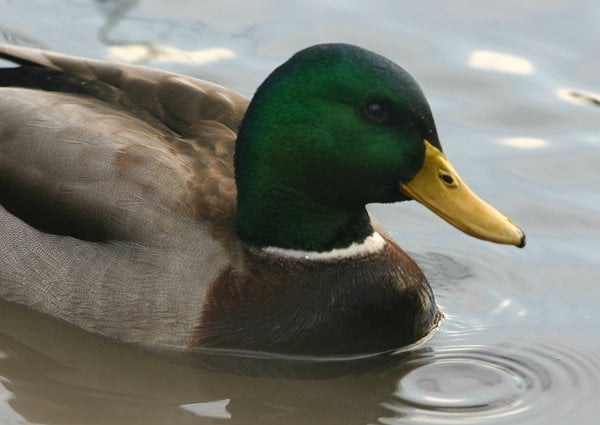
Everyone knows what a male Mallard looks like. The drake of this extremely common, sexually dimorphic species (Anas platyrhynchos) cuts a fine form with his iridescent emerald dome and chestnut breast. A female mallard possesses plumage as dull as her partner’s is bold, a frock of forgettable grays, browns, and blacks. Yet you would be wise to take a second look at that mallard hen. Check out this bird:
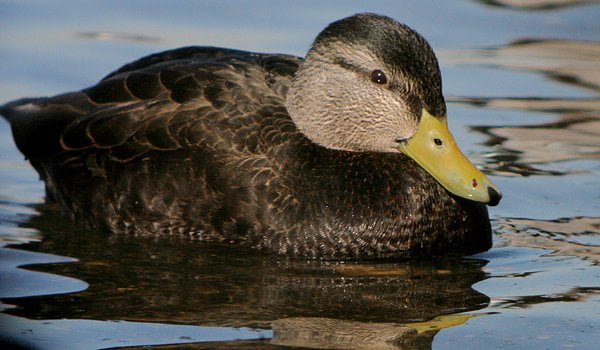
Now look at this one:
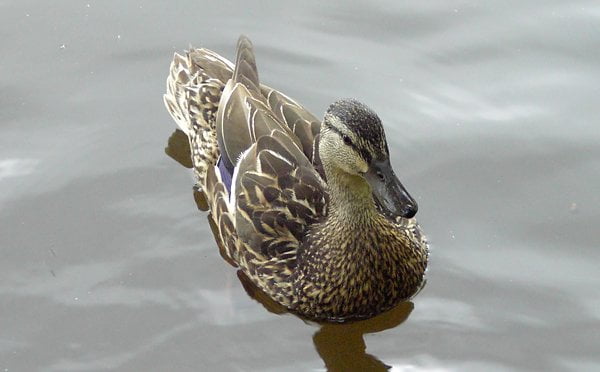
And finally, this one:
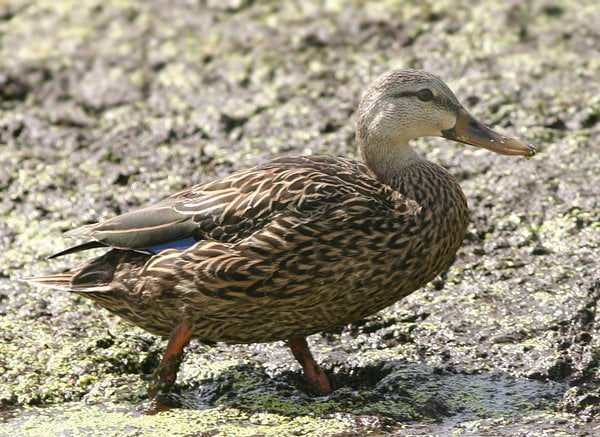
Which of these birds, if any, are Mallards? Answers will be forthcoming, but for now, I can tell you that they are all members of the mallard complex, a roster of about 20 closely-related Anas-species ducks around the world.
The mallard is a mighty duck indeed, successful all across its broad range from the Americas through Eurasia down into Australia and New Zealand. Not only are most domesticated duck breeds descended from A. platyrhynchos, but many distinct populations of wild ducks have sprung from the productive loins of this dynamic dabbler. Most of these species are monomorphic and more closely resemble the mallard hen. If you had trouble separating the American Black Duck (A. rubripes), Mallard, and Mottled Duck (A. fulvigula) in the photos above (in that order), you’re hardly alone. The ducks themselves seem to have the same difficulty, as these three species interbreed freely. Such hybridization threatens to undermine A. rubripes and fulvigula as separate species, just as the Mexican Duck (A. diazi) was compromised into mere mallard race status. The Hawaiian Duck (A. wyvilliana) and Laysan Duck (A. laysanensis) also balance on that fine line between species and subspecies.
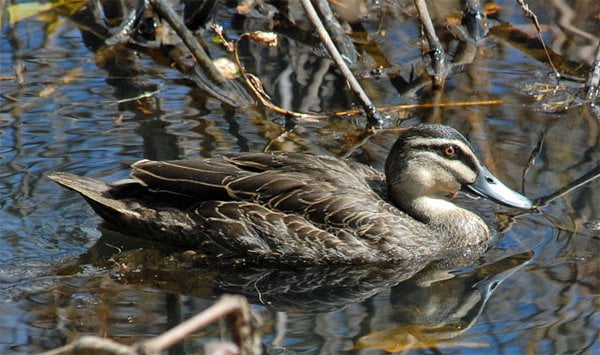
Also not (yet) a Mallard, but rather a Pacific Black Duck (c) Bronwen Scott
The genus Anas, dabblers all, includes wigeons, shovelers, teals, and pintails as well as mallards. It’s difficult to say which birds on this list are part of the mallard complex, but many of them, especially the females of the species, show superficial or structural mallard traits.
Here’s a bonus piece of mallard complex trivia: If the extinct Mariana Mallard (A. oustaleti) is ever granted posthumous species status, it will represent one of the most short-lived vertebrate species known to science, with a lifespan measured only in tens of thousands of years from the first rendezvous between Mallard and Pacific Black Duck (A. superciliosa rogersi) to the death of the last individual in 1981.
Members of the mallard complex, whether purebred or hybrid, wild or manky, exemplify how blisteringly successful generalist genera can be in a rapidly changing world. Plus, they are super cute when they’re young…
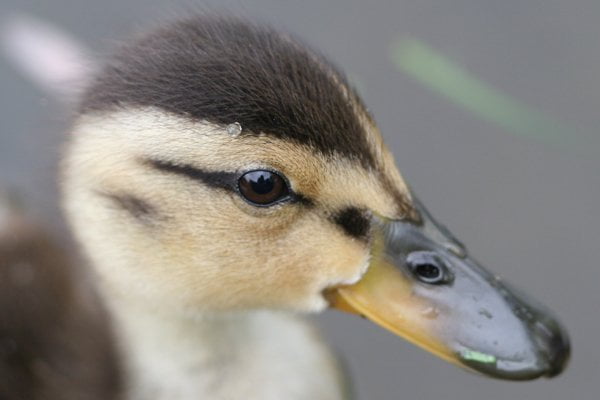
(This post was first published in February 2011, but the might of the Mallard continues unabated and deserves further attention!)









Hi,
I was hoping to find out what the capacity of the Mallards night vision is?
This morning my family and I found a dead female Mallard on our front lawn. We’re trying to find out, as best we can, what caused her demise.
We’re going through several possibilities. Right now, maybe she hit our house, breaking her neck.
Any info would be greatly appreciated!!
Hillary
i have mallards in a large 60 sq meters aviary.been breeding them for ten years now. during this time i have seen many baby ducks probably thousants. i consider them very smart birds and they r able to lern. they r exelent mothers and will charge anything to protecttheir babies even me. they r extremely hard under harsh weather conditions and during blizards and heavy wind and snow they never hide from the cold but instead they sit in the open facing the direction of the wind sometimes been covered with snow but they dont seem to mind. the male mallards are very beautifull and proud and they seem to know it and show off a bit.i like the mallards so much that i cant imagine my garden without them around
I have several photos of a Duck to identify from my cottage lake in Ontario. It looks like a pair of Mexican race Mallards. Can you help me identify? If yes, how can I send them to you. Thanks.
Alison, you can contact me directly at mike AT 10000birds DOT com. First though, I suggest you check our extensive pages on Hybrid Mallards and “Manky” (domestic, feral, or just plain odd) Mallards.
I have seen a lot of baby mallards. How can you tell ifone of the babies is going to be male or female? They all seem to be mostly brown in color.
Thanks
Mallard duck question –
We live in central Florida next to a 1 acre pond. This spring there have been two separate sets of baby ducks that have disappeared. The first of 11 and the last group of 6 were only around for 2 days or so. There is also a pair of babyless mallards on the pond. On each occasion the babyless mallards (believed to be an immature male and female) harrased the mother with babies. We feel that the babies were killed by these two babyless ducks.
Question: Are mallards so territorial that this behavior is possible?
Thanks
Mike in CFL
We take care of a female mallard who has been living on our salt water canal for more than 7 years. I feed her cracked corn from a bowl (to keep the other birds away from it) which she loves. She likes to have a sip of water with each mouthful of corn.
She was hurt and abandoned many years ago. A few years ago she was no longer able to get on the dock alone and we thought she would die because she had no fresh water but we built her a platform so that when the tide is high she can hop on and come onto the lawn for water & a nap and of course food. She’s had a rough life not being with other ducks but at least she has us!
The second one looks like a Pacific black duck to me. But I am often wrong about bird IDs!
Don’t I wish, Snail. If I spotted a Pacific black duck in Putnam County, NY and didn’t tell anyone, I’d be a pariah!
*shakes fist at mallard*
we had 2 mallard walk up our lawn and they were very Friendly. She made a nest next to the lake. Every day they walk up our huge hill and want something to eat. I fee them a mixture of fish pellets and mixed bird seed and they love it. I know can pet the femail who has 5 eggs on her nest. Now she is sitting on the nest all day and night. I have been bring her water and food and she gives me a soft akakak sound. When the babies hatch will she be protective of me near them? she lets me pet her and I try to use some of the duck sounds and they both quack back to mel Is it true that the male will leave the femle after the ducks. Dont they mate for life? I am so enjoying them, will they stay in our area.
( ‘)>
Clearly I’m not the only one who appreciates Mallards! A few days ago I went to the Skagit, an area famous in Washington State for winter birds. I loved seeing 10,000 Snow Geese, 1,400 Trumpeter Swans, etc. But the Mallards were also stunning, thousands and thousands of them roaming and foraging in the frozen fields.